
Woodworking Tools · Band Saws
Best Band Saws for Woodworking: 12 Machines Ranked for Curves, Resawing and Everyday Shop Work
From benchtop saws that fit on a folding table to floor-standing machines built for all-day resawing, here is how today’s most popular woodworking band saws compare — and which one actually matches the work you do.
The Complete Buyer’s Guide
The Band Saw Is the Quiet Workhorse of a Woodworking Shop
Ask a room full of woodworkers which single saw they would keep if they could only keep one, and the band saw wins more often than you would expect. It is the only machine in most shops that will cut a sweeping curve in a table leg, slice a wide board into book-matched veneer, rough out a bowl blank, and trim a tenon cheek — all with the same blade and with far less kickback risk than a spinning circular blade.
That versatility is exactly what makes choosing one so confusing. The category stretches from small benchtop units that cost less than a decent hand plane all the way to cast-iron floor models that weigh as much as a refrigerator. Product pages blur the differences with jargon: throat capacity, resaw height, blade tension, guide bearings, two-speed pulleys, worm-gear tensioners. If you have never owned one, it is genuinely hard to tell which numbers translate into cleaner cuts in your actual shop.
This guide cuts through that. We grouped twelve of the most widely available woodworking band saws into three honest categories — stationary shop saws, benchtop and compact saws, and portable or cordless models — then compared them on the things that change your day-to-day results: cut quality, ease of setup, build confidence, dust control, safety, and long-term value. Every product below has its own review block so you can see exactly who it suits and where it stretches thin.
Whether you are outfitting a first shop and reading about what woodworking really involves, or you are upgrading a saw you have outgrown, the goal is the same: one machine that earns the floor space and never becomes the tool you apologize for.
Ready to Start Shopping?
Compare current prices and availability across the band saw category.
Browse Band Saws on Amazon
At a Glance
Quick Comparison: Our Top Picks
Every saw in this guide appears below. Read the “Best For” label first — it tells you instantly whether a machine belongs in a compact hobby shop or a full-time workspace. Then jump to the full review blocks further down for the details.
| # | Image | Product | Key Specs | Verdict | Check Price |
|---|---|---|---|---|---|
| Top Pick 1 |
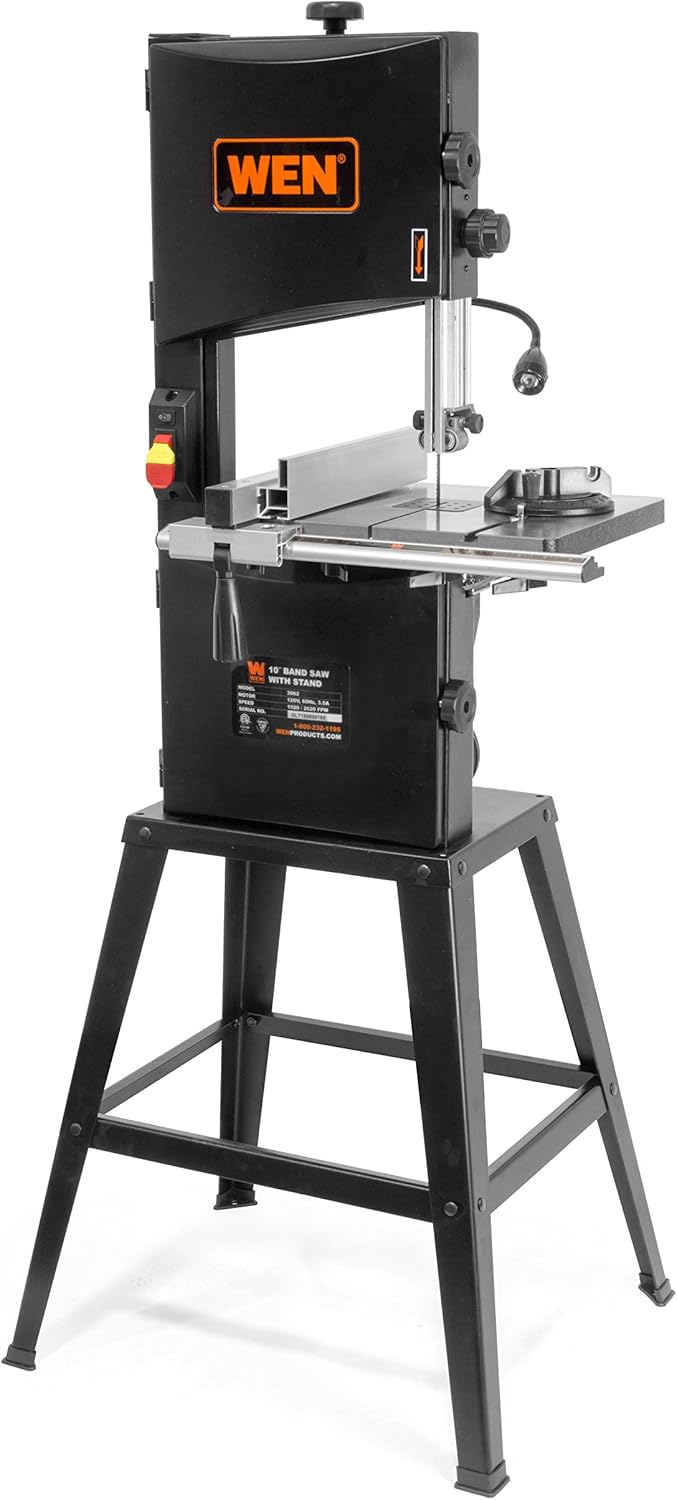 |
WEN BA3962 10″ Two-Speed Band Saw with StandBest Overall |
|
Serious shop capability in a hobby-friendly footprint. | Check Price on Amazon |
| 2 | |
JET JWBS-14SFX 14″ Woodworking Band SawBest Heavy-Duty Shop Saw |
|
Built for daily resawing and all-day production work. | Check Price on Amazon |
| 3 |  |
Rikon 10-3061 10″ Deluxe Band SawBest Compact Deluxe |
|
Refined details for woodworkers who value precision. | Check Price on Amazon |
| 4 |  |
Grizzly Stationary Band SawBest for a Dedicated Shop |
|
A fixed fixture that rewards careful installation. | Check Price on Amazon |
| 5 |  |
QD-KYOHO 14″ 2 HP Band SawBest for Heavy Resawing |
|
Real power for thick, dense and stubborn stock. | Check Price on Amazon |
| 6 | 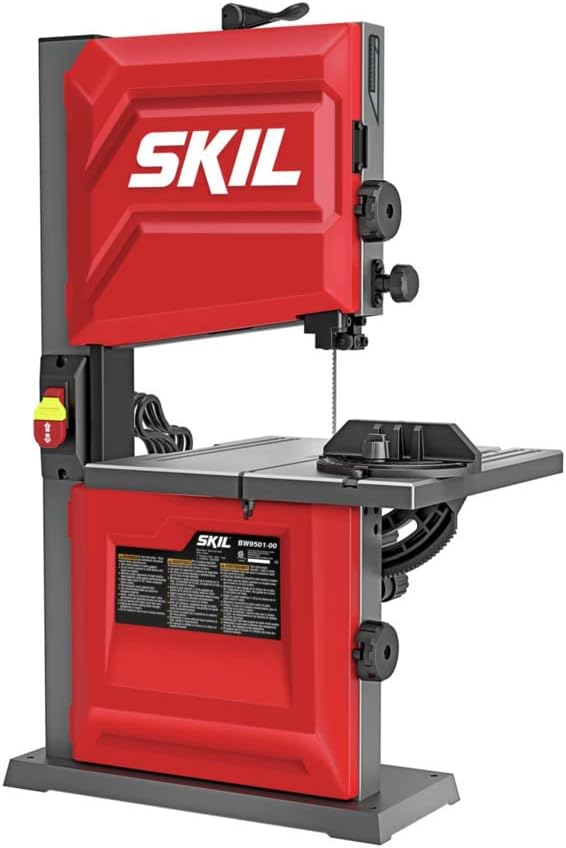 |
SKIL BW9501-00 9″ Two-Speed Benchtop Band SawBest Budget Benchtop |
|
An easy, low-risk first step into bandsaw work. | Check Price on Amazon |
| 7 |  |
ShopMax Benchtop Band SawBest Value Benchtop |
|
Straightforward, no-fuss saw for occasional work. | Check Price on Amazon |
| 8 |  |
Seesii Benchtop Band SawBest Compact Portable |
|
Easy to store, easy to bring to a job. | Check Price on Amazon |
| 9 |  |
Woodskil Band SawBest for Beginners |
|
A forgiving introduction to curved and rough cuts. | Check Price on Amazon |
| 10 |  |
Milwaukee Cordless Band SawBest Cordless Jobsite Saw |
|
Grab-and-go cutting wherever the work is. | Check Price on Amazon |
| 11 |  |
DeWalt DCS378B 20V MAX XR Cordless Band SawBest Premium Cordless |
|
A refined cordless saw for demanding daily use. | Check Price on Amazon |
| 12 |  |
PowerSmart Portable Band SawBest Budget Portable |
|
Affordable portability for occasional cutting tasks. | Check Price on Amazon |
See Today’s Prices
Short on time? Compare the full category in one place.
Check Band Saw Prices on AmazonSection 01
Why a Band Saw Earns Its Floor Space
There is a particular moment in every woodworker’s development when the limitations of other saws become obvious. You want a table leg with a gentle curve, and a straight-line saw simply cannot follow it. You want two book-matched panels from a single board, and resawing on a table saw means wrestling a tall board past a blade that wants to grab it. You want to rough out a shape before refining it with a router or hand tools, and nothing in the shop makes that quick and safe. The band saw answers all three problems with the same thin, continuous blade moving in one direction.
Curves are its native language
Because the blade is narrow and cuts on a downward stroke, the workpiece can be rotated freely on the table while the cut is in progress. That is the entire trick behind curved work: cabriole legs, template shapes, rocker parts, decorative brackets, toy wheels, scroll-style trim. Where a jigsaw wanders and a router needs a template, the band saw follows a marked line with a stable, repeatable kerf. Once you have cut your first clean curve on a tuned band saw, you start designing differently because you know the machine can follow the line.
Resawing changes what you buy
Resawing is the act of slicing a board along its thickness, turning one thick piece into two thinner ones. It is how woodworkers create matched panels, produce their own thin stock instead of buying it, and get the most out of a prized board. It is also the single best argument for a larger saw, because resaw height — the vertical clearance under the upper guide — determines how tall a board you can stand on edge. A larger frame saw in the 14-inch class typically gives you far more of that clearance than a compact benchtop model.
If your ambitions include furniture work, take a look at our guides to the best woodworking workbenches and the best wood for a woodworking bench, because the bench and the saw tend to be the two purchases that shape everything else you build.
It is the safer way to do certain cuts
A band saw blade moves downward into the table, which means the cutting force pushes the workpiece down rather than back at you. There is no rotational energy stored in the blade waiting to throw a offcut. For rough-cutting curves, trimming small parts, and cutting tenon cheeks or lap joints, that downward force is a genuine safety advantage over a circular blade. It does not make the machine harmless — we cover proper technique in the safety section — but it does make the band saw the saw most woodworkers feel comfortable using with small or awkward parts.
It replaces three or four other operations
Between curves, resawing, rough dimensioning, joinery cleanup, and template work, a band saw absorbs jobs that would otherwise demand a jigsaw, a scroll saw, a second table saw pass, and a lot of hand-sawing. That consolidation is why so many of the tools in our essential woodworking tools roundup end up sitting on a shelf once a good band saw arrives. It is also why the saw pairs naturally with the jointery skills explained in our wood joinery tools guide — a band saw is the machine that prepares the parts before the chisel and the dado or rabbet work begins.
Start With the Right Saw
See which band saws are available in your size class.
Shop Band Saws on AmazonSection 02
How We Selected These Band Saws
Band saw reviews tend to fall into two unhelpful camps: spec sheets read aloud, or vague enthusiasm. We aimed for the middle — practical judgment built on the criteria that actually determine whether a saw is a pleasure or a punishment to own. Nothing here is a lab test result, and we have deliberately avoided invented numbers, star ratings, and review counts. Where a specification could not be confirmed, we describe the characteristic in plain language instead of guessing.
Cut quality and tracking stability
The first question about any band saw is simple: does the blade stay where you put it, and does it leave a surface you can work with? Tracking stability depends on the wheels, the tires, the tension mechanism, and the guide system working together. A saw that drifts mid-cut forces you to fight the workpiece instead of guiding it, and no amount of extra power fixes that.
Setup and tuning effort
Every band saw needs some assembly and adjustment out of the box. The difference is how much. We favor saws whose adjustments are intuitive, whose guides are accessible, and whose fences lock without creeping. A machine that is easy to set up correctly gets used; a machine that stays misaligned gets resented.
Build confidence and vibration
Stiff frames, solid tables, and well-machined trunnions translate into accuracy over years. Vibration is the visible symptom of the opposite. We pay attention to how a saw feels at the table — whether it hums or rattles, whether the table sits flat, whether the adjustments hold after a few blade changes.
Dust control and daily livability
A band saw makes fine dust that stays airborne. A usable dust port, a sensible guard design, and an easy path to hook up a shop vacuum matter more than most buyers expect. So does noise, storage footprint, and how easily the machine can be moved if your shop doubles as a garage.
Value over time, not just purchase price
A cheap saw that needs constant adjustment or burns through blades is expensive in disguise. We weight long-term ownership — blade availability, replaceable wear parts, and how well the saw holds its settings — alongside the sticker price. For broader context on building out a shop wisely, our guide to setting up a beginner woodshop is a good companion read.
A note on honesty: the labels in this guide — “Best Overall,” “Best Budget,” and so on — reflect our judgment of who each saw suits, not a ranking of quality across categories. A benchtop saw is not a “worse” saw than a floor model; it is a saw built for a different shop.
Ready to Compare Options?
Browse the category and read current buyer feedback.
Browse Band Saws on AmazonSection 03
Best Stationary Shop Band Saws
These are the machines that claim a permanent spot on the shop floor. They are heavier, taller, and built for woodworkers who cut regularly — furniture makers, cabinet shops, small production runs, and serious hobbyists who have outgrown a benchtop saw. If you have the space and the projects to justify it, this is the class where resawing becomes routine rather than a special event.
| # | Image | Product | Key Specs | Check Price |
|---|---|---|---|---|
| Top Pick 1 |
|
WEN BA3962 10″ Two-Speed Band Saw with StandBest Overall |
|
Check Price on Amazon |
| 2 | |
JET JWBS-14SFX 14″ Woodworking Band SawBest Heavy-Duty |
|
Check Price on Amazon |
| 3 | |
QD-KYOHO 14″ 2 HP Band SawBest for Heavy Resawing |
|
Check Price on Amazon |
| 4 | |
Grizzly Stationary Band SawBest Dedicated Shop Saw |
|
Check Price on Amazon |
WEN BA3962 10″ Two-Speed Band Saw with Stand
The WEN BA3962 is the saw we point most people toward when they ask for “the one that does everything reasonably well.” It sits in the 10-inch class, which is the sweet spot for home shops: large enough for real curved work and light resawing, small enough that it does not swallow a garage corner. The included stand is a bigger deal than it sounds — it puts the table at a comfortable working height and keeps the saw from becoming a permanent tenant of your workbench.
Two-speed operation is the standout feature in this class. Switching between speeds lets you match the blade’s pace to the material and the cut: faster for clean, efficient cuts in softer stock and thinner material, slower when you want control in harder wood or when you are following a demanding curve. It is the kind of feature that sounds like marketing until you use it and realize how much smoother your cuts become.
Key Features
- 10-inch class frame sized for home and small professional shops
- Two-speed operation for matching blade speed to material and cut type
- Stand included for comfortable working height and stable setup
- Standard blade-change and tracking adjustments that a beginner can learn quickly
- Dust collection port for connecting a vacuum or dust extractor
What We Like
- Versatile size that handles most hobby and light furniture work
- Two speeds give noticeably more control than single-speed saws
- Stand saves bench space and improves ergonomics
- Easy to set up and to keep tuned
Keep in Mind
- Not intended for continuous production resawing
- Serious furniture makers may eventually want a larger frame
JET JWBS-14SFX 14″ Woodworking Band Saw
This is the saw for woodworkers who have stopped thinking of the band saw as an occasional-use machine. The JWBS-14SFX is purpose-built for woodworking rather than adapted from a metal-cutting design, and that focus shows up in the details: the working height, the guard and guide arrangement, the table support, and the way the machine behaves during long resaw cuts. It is a floor-standing tool meant to be set up once, dialed in, and then relied upon.
The 14-inch class is where resawing becomes practical for furniture work. Boards standing on edge for book-matched panels, thick table legs roughed out from solid stock, wide boards sliced into usable thickness — these are everyday operations on a saw of this size rather than stressful special occasions. If your projects keep demanding more height under the guide, this is the tier to shop in.
Key Features
- 14-inch class frame with generous working clearance for resawing
- Design built around woodworking rather than general metalwork
- Floor-standing format with stable, permanent positioning
- Guide and guard system designed for repeatable, accurate cuts
- Dust port sized for a proper shop dust collection hookup
What We Like
- Confident handling of wide and tall stock
- Stable platform that holds its settings over time
- Comfortable working height reduces fatigue on long projects
- Purpose-built for woodworkers’ actual cutting tasks
Keep in Mind
- Requires dedicated floor space and a firm installation spot
- More saw than a purely hobby-focused shop typically needs
QD-KYOHO 14″ 2 HP Band Saw
Power is the headline here. The QD-KYOHO pairs a 14-inch frame with a 2 HP motor, which is the combination that keeps blade speed from collapsing when you push a wide board through a resaw cut. Anyone who has watched a saw slow down and chatter halfway through a hardwood board knows exactly why that matters: the cut wanders, the surface turns rough, and the blade overheats.
What makes this saw interesting is that it delivers that muscle in a stationary format aimed at woodworkers rather than in an industrial package that needs its own room. For a shop that regularly slices thick stock, turns green wood, or works with dense species, the extra power is not a luxury — it is the difference between a cut you trust and one you have to sand out.
Key Features
- 14-inch frame for tall and wide resaw work
- 2 HP motor for sustained cutting power in demanding stock
- Stationary format built for permanent shop installation
- Straightforward blade change and tracking adjustment points
- Dust collection connection for cleaner working conditions
What We Like
- Strong motor that holds up under heavy feed pressure
- Well suited to resawing and thick hardwood work
- Large frame class with plenty of working clearance
- Good fit for a shop moving into production-level output
Keep in Mind
- Overkill for occasional light-duty cutting
- Demands a stable, permanent spot and proper power supply
Grizzly Stationary Band Saw
Some saws are bought to be used; others are installed to become part of the shop. The Grizzly Stationary Band Saw belongs in the second group. It is a fixed, floor-standing machine for woodworkers who have committed the space and want a saw that behaves like a permanent fixture — steady, predictable, and ready whenever the project calls for it.
Stationary saws reward the time you put into installation. Level the base, align the table, set the guides carefully, hook up dust collection, and the machine will return that investment with clean cuts for a very long time. If you enjoy the process of tuning a tool to its best performance — the same satisfaction described in our guide to improving woodworking skills — this category will appeal to you.
Key Features
- Stationary, permanent-shop design with a stable base
- Shop-grade construction intended for regular use
- Large working area for furniture-scale workpieces
- Adjustable guides and tracking for precision setup
- Dust collection port for a cleaner shop environment
What We Like
- Rock-solid stability that shows up in cut accuracy
- Built for woodworkers with recurring, demanding projects
- Holds its tuning well between blade changes
- Comfortable for long working sessions
Keep in Mind
- Not a portable or space-saving solution
- Best value for shops that cut frequently
View the Grizzly Stationary Band Saw
A permanent fixture for a dedicated woodworking shop.
Check Price on AmazonBuilding Out a Full Shop?
Pair your band saw with the right supporting tools and setup.
Shop Stationary Band SawsSection 04
Best Benchtop and Compact Band Saws
Not every shop has room for a floor-standing machine, and not every project needs one. Benchtop band saws are the entry point for most woodworkers, and they have improved dramatically — a good compact saw today will cut clean curves, handle small resawing tasks, and fit on a shelf when the job is done. This group covers the saws that shine in apartments, shared shops, garages, and classrooms.
| # | Image | Product | Key Specs | Check Price |
|---|---|---|---|---|
| Top Pick 1 |
|
Rikon 10-3061 10″ Deluxe Band SawBest Compact Deluxe |
|
Check Price on Amazon |
| 2 | |
SKIL BW9501-00 9″ Two-Speed Benchtop Band SawBest Budget Benchtop |
|
Check Price on Amazon |
| 3 | |
ShopMax Benchtop Band SawBest Value Benchtop |
|
Check Price on Amazon |
| 4 | |
Seesii Benchtop Band SawBest Compact Portable |
|
Check Price on Amazon |
| 5 | |
Woodskil Band SawBest for Beginners |
|
Check Price on Amazon |
Rikon 10-3061 10″ Deluxe Band Saw
Rikon has a reputation among woodworkers for building saws with the kind of detail work usually reserved for larger machines, and the 10-3061 carries that approach into a compact, bench-friendly package. “Deluxe” here is not just a name — it reflects a machine designed for woodworkers who care about fine adjustment, clean cuts, and a tool that feels considered rather than merely adequate.
The 10-inch class is a smart size for many shops. It is big enough to handle the curved parts, small resawing tasks, and joinery prep that make up most hobby and light furniture work, yet it can live on a sturdy workbench or a small stand. If you want the refinement of a woodworking-focused saw without surrendering an entire corner of the shop, this is a strong place to land.
Key Features
- 10-inch class size that balances capability and footprint
- Deluxe adjustment points for tracking, guides, and blade tension
- Woodworking-focused design and table arrangement
- Compact format suitable for benchtop or small stand mounting
- Dust collection port to keep fine dust under control
What We Like
- Thoughtful adjustments that make tuning feel precise
- Excellent fit for detail-oriented hobby and small-shop work
- Compact enough for a shared or multi-use workspace
- Smooth, controlled cuts in curved work
Keep in Mind
- Resaw capability is limited compared with larger frame saws
- Not intended for high-volume production resawing
SKIL BW9501-00 9″ Two-Speed Benchtop Band Saw
If you are not yet sure how much you will use a band saw, spending heavily is a gamble. The SKIL BW9501-00 is the sensible way to find out. It is a compact 9-inch class benchtop saw with two-speed operation — a feature that many saws at this level skip — giving you useful control over how aggressively the blade works through different materials and cut types.
The appeal is accessibility. It sets up quickly, fits in a small space, and handles the everyday band saw jobs: curves, trimming small parts, roughing out shapes, and light resawing of thinner stock. For a first saw, a teaching shop, or a maker who only breaks out the band saw a few times a month, it delivers the experience without the commitment.
Key Features
- 9-inch class compact design that fits almost anywhere
- Two-speed operation for matching blade pace to the job
- Benchtop format — no dedicated floor space required
- Simple adjustments that a first-time user can learn quickly
- Dust collection connection for cleaner small-shop working
What We Like
- Low barrier to entry for anyone new to bandsaw work
- Two speeds add real versatility at this size
- Stores easily in a garage or shared workspace
- Great for learning technique before upgrading
Keep in Mind
- Limited clearance for tall resaw work
- Best matched to light and occasional use
ShopMax Benchtop Band Saw
The ShopMax takes the straightforward approach: a benchtop band saw that does the basics well, without extra complexity or cost. There is real value in that. Not every woodworker needs two speeds, a cast-iron table, or a resaw capacity they will never use — plenty of us need a reliable machine that cuts where the line is marked and stows away afterward.
Its small footprint makes it a good fit for multi-use spaces where the workshop has to disappear at the end of the day. Pair it with a sturdy bench — see our recommendations for the best portable woodworking workbench if your shop needs to fold away — and you have a functional cutting station that takes minutes to set up.
Key Features
- Compact benchtop format for small and shared workspaces
- Light-duty cutting suited to hobby and craft projects
- Straightforward controls with minimal setup
- Easy to move, store, and bring out when needed
- Dust collection connection for basic shop cleanliness
What We Like
- Simple and approachable — no steep learning curve
- Small footprint that respects a shared space
- Good value for occasional and craft-level work
- Easy to keep clean and put away
Keep in Mind
- Not designed for heavy or continuous cutting
- Fewer refinement features than deluxe models
Seesii Benchtop Band Saw
Portability is an underrated quality in a band saw. If you work in a shared makerspace, teach classes, move between job sites, or simply need to reclaim your bench at the end of a project, a saw you can lift and carry is worth a great deal. The Seesii is built around exactly that idea: a benchtop format that stays light, compact, and easy to relocate.
Do not read “portable” as “toy.” A compact saw like this handles the everyday band saw tasks well — curves, small parts, template work, thin resawing — and the ability to set it up on any stable surface means it gets used more often than a heavy machine that is awkward to reach.
Key Features
- Light, compact benchtop design for easy carrying and storage
- Small footprint that works on almost any stable surface
- Suited to craft, hobby, and light woodworking projects
- Quick setup and teardown for shared workspaces
- Dust connection for keeping a temporary workspace clean
What We Like
- Genuinely easy to move and store
- Ideal for makerspaces, classrooms, and multi-use rooms
- Low commitment — set up only when you need it
- Comfortable for small, detailed work
Keep in Mind
- Lighter build means less mass for demanding cuts
- Not the choice for large furniture-scale resawing
Woodskil Band Saw
Learning a band saw is mostly about confidence: feeding at a steady rate, keeping the line, and resisting the urge to force the cut. A forgiving machine helps enormously. The Woodskil is a mid-size saw aimed squarely at new woodworkers and hobbyists building their first projects — the kind of tool that lets you make mistakes, adjust, and improve without punishing you for every one.
If you are just getting started, this pairs well with a simple project list. Our collection of easy woodworking projects for beginners is a natural companion, because a band saw earns its keep fastest when it is put to work on real builds rather than test cuts.
Key Features
- Mid-size format suited to hobby and starter projects
- Friendly setup and adjustment for first-time users
- Handles curves, trimming, and light resawing tasks
- Compact enough for a home or garage shop
- Dust collection port for a cleaner learning environment
What We Like
- Approachable for someone with no bandsaw experience
- Versatile enough to grow with your skill level
- Good balance of size and capability
- Encourages good technique early on
Keep in Mind
- Advanced woodworkers may want more refinement
- Capacity is oriented toward smaller and mid-size projects
Shopping on a Smaller Bench?
Compare compact band saws sized for home workshops.
Shop Benchtop Band SawsSection 05
Best Portable and Cordless Band Saws
Not all cutting happens at the bench. Trimming parts on site, breaking down material where it lands, working on an installed project, or handling cutting tasks away from power outlets — these are the jobs where a portable band saw earns its keep. Modern cordless models have closed the gap considerably, and the format offers a kind of freedom that a stationary saw simply cannot.
| # | Image | Product | Key Specs | Check Price |
|---|---|---|---|---|
| Top Pick 1 |
|
DeWalt DCS378B 20V MAX XR Cordless Band SawBest Premium Cordless |
|
Check Price on Amazon |
| 2 | |
Milwaukee Cordless Band SawBest Cordless Jobsite Saw |
|
Check Price on Amazon |
| 3 | |
PowerSmart Portable Band SawBest Budget Portable |
|
Check Price on Amazon |
Milwaukee Cordless Band Saw
Milwaukee’s cordless band saw is built for the reality of working away from a bench: grab it, cut, move on. The cordless format eliminates the single biggest annoyance of portable cutting — finding power and managing a trailing cable — and makes the saw genuinely useful in tight spaces, on ladders, in basements, or anywhere a cord cannot comfortably reach.
For woodworkers who also do installation, remodeling, or on-site finishing, this kind of tool slots into a workflow that a stationary saw cannot. It is the saw that lives in the truck or on the shelf by the door, ready for the quick trimming job that would otherwise mean disassembling your setup.
Key Features
- Cordless operation for cutting anywhere in or out of the shop
- Portable, one-handable format for tight and awkward spaces
- Designed for quick, frequent cuts during installation work
- Compact body that stores easily in a vehicle or on a shelf
- Minimal setup — pick it up and cut
What We Like
- True portability with no cord management
- Excellent for on-site and installation work
- Fast to deploy for quick trimming jobs
- Comfortable in spaces a stationary saw cannot reach
Keep in Mind
- Not a substitute for a stationary woodworking band saw
- Format favors quick cuts over furniture-grade curve work
DeWalt DCS378B 20V MAX XR Cordless Band Saw
The DCS378B sits at the refined end of the cordless band saw category. It is built around DeWalt’s 20V MAX XR platform, which matters more than it might seem: if you already run that battery system, adding this saw is a straightforward decision, and if you are building a cordless kit, it is a platform with a long track record and broad accessory support.
In practice, this is the saw for the woodworker who values a polished, predictable tool — smooth trigger response, consistent cutting behavior, and a body that holds up to daily handling. It is the kind of portable saw that professionals reach for repeatedly rather than occasionally.
Key Features
- 20V MAX XR cordless platform for consistent, portable power
- Portable format designed for one-handed and overhead work
- Refined handling for frequent, repeated cutting tasks
- Compact body for storage and transport
- Integrates with an established cordless tool system
What We Like
- Polished, dependable feel during use
- Battery platform shared with many other tools
- Well suited to daily professional use
- Easy to handle in confined spaces
Keep in Mind
- Priced at the premium end of the portable category
- Not intended for curve-driven furniture work
PowerSmart Portable Band Saw
Sometimes you need portability more than you need premium features. The PowerSmart Portable Band Saw is aimed at exactly that buyer: someone who wants the freedom to cut where the work is, without paying for capabilities they will not use. It handles the straightforward cutting jobs — trimming, rough sizing, quick corrections — that make up a surprising share of real project work.
As with any budget-friendly tool, the value comes from matching it to the right tasks. Used for what it is designed for, it is a practical addition to a shop that already owns a stationary saw, or a sensible first cutting tool for someone starting with repair and hobby projects.
Key Features
- Portable format for cutting in place and on the move
- Compact body that stores in limited space
- Light-duty cutting suited to repair, hobby, and trim work
- Straightforward operation with minimal setup
- Accessible entry point into portable bandsaw cutting
What We Like
- Affordable way to add portable cutting capability
- Light and easy to maneuver
- Good fit for occasional and repair-oriented work
- Simple to operate with little experience
Keep in Mind
- Best for lighter tasks rather than continuous production
- Fewer refinement features than premium cordless models
Need Cutting Power on the Move?
Compare portable and cordless band saws side by side.
Shop Cordless Band SawsSection 06
The Specs That Actually Matter When You Buy
Product pages are full of numbers, but only a handful of them change how a band saw performs in your shop. Here is what to read carefully, what to read loosely, and what to ignore entirely when you are comparing models.
Throat capacity: how wide you can cut
Throat is the distance between the blade and the vertical frame of the saw. It determines the maximum width of a workpiece you can pass through. This is the number that sizes the saw in most naming conventions — a “14-inch” saw refers to this dimension, not the blade length. If you build wide panels or large curved shapes, throat matters; if you mostly cut small parts, it matters far less.
Resaw capacity: how tall you can cut
Resaw capacity is the height available under the upper guide when it is raised to its working position, and it is the spec that decides how thick a board you can slice into two. It is the single biggest differentiator between compact and full-size saws, and the reason many woodworkers eventually upgrade. If book-matched panels, custom thin stock, or thick furniture parts are in your future, prioritize this number above almost everything else.
Motor power and speed control
More power is always welcome, but it matters most when the blade is buried in a wide, hard board. A saw with adequate power for its size will hold speed through the cut; an underpowered one slows, wanders, and leaves a rough surface. Speed control — whether through two-speed pulleys or variable control — lets you match blade pace to the material and to the cut. Slower speeds favor control and harder stock; faster speeds favor clean, efficient cuts in softer materials.
Table, fence, and workpiece support
A flat, square table is non-negotiable, and the ability to tilt for angled cuts is a genuine advantage. A good fence transforms the band saw from a curve-cutting tool into a resawing machine, because it holds the board at a fixed distance from the blade across a long cut. Look for a fence that locks positively and stays put. Miter gauge slots and a solid workpiece support surface make awkward parts far safer to handle — the same logic behind a good bench vise holding work steady for hand operations.
Guide system: the heart of accuracy
The guides keep the blade from twisting during a cut. Bearing guides are durable and low-friction; block guides are simple and effective when properly set. Whatever the type, the guides must be adjustable, accessible, and easy to set close to the workpiece. This is the mechanism you will touch most often, so it should not require contortions to reach.
Dust collection and the reality of fine dust
Band saws produce a large volume of fine dust that stays airborne far longer than chips. A properly sized dust port, positioned to catch what the guard throws downward, is a health feature as much as a cleanliness one. Plan for it from the start rather than retrofitting later.
One more tip from experience: think about the whole toolchain, not just the saw. The band saw prepares parts; tools like the jointer and the jigs you build around your machines determine how accurate those parts become.
Compare Specs Side by Side
Review current band saw listings and specifications.
Browse Band Saws on AmazonSection 07
Blades, Guides, and First Setup
Half of what people blame on an inexpensive band saw is actually a setup problem. Blade choice, tension, tracking, and guide adjustment account for an enormous share of cut quality, and all of them are within your control. Get these right and even a modest saw will surprise you.
Choosing the right blade
Blade width governs how tight a curve you can cut. Narrow blades turn sharp corners; wide blades cut straighter and resist deflection during resawing. Most woodworkers keep at least two blades: a narrow one for curves and a wider one for straight cuts and resawing. Tooth count matters too — fewer, larger teeth clear waste efficiently in thick stock, while more closely spaced teeth give a smoother finish in thinner material.
Tension and tracking
Tension keeps the blade seated and cutting straight; tracking centers the blade on the wheels. Both are set with the adjustment mechanisms on the saw, and both are worth re-checking after every blade change. A blade that is too loose wanders and deflects; one that is over-tightened stresses the wheels, tires, and bearings. The right setting is the one where the blade runs quietly, stays centered, and deflects only slightly under side pressure.
Setting the guides
Guides should sit as close to the workpiece as possible without touching it, and the upper guide height should be adjusted every time you change the thickness of what you are cutting. This is the adjustment most people skip, and it is the one that most improves cut accuracy. Small, frequent adjustments beat one big setup at the beginning of the day.
Building a cutting workflow
A band saw works best as part of a system. Rough shapes on the saw, refine with a router or a random orbital sander, and hold work with good clamps during assembly. If you are still assembling your core kit, our guide to chisel sets for beginners and cordless drills for woodworking covers the tools that most often sit alongside the band saw on a first project.
Quick rule of thumb: if the cut is wandering, check guide placement and feed rate before you blame the saw. Most wandering blades are being pushed faster than they can clear waste.
Get the Right Blade
The fastest upgrade to any band saw is a quality blade.
Shop Band Saw Blades on AmazonSection 08
Maintenance and Long-Term Tuning
A band saw is one of the lower-maintenance machines in a woodworking shop, which is exactly why the small amount of care it does need is so often neglected. A short routine keeps cut quality consistent and prevents the slow drift that turns accurate work frustrating.
Keep the wheels and tires clean
Resin and dust build up on the wheel tires over time, and that buildup changes how the blade tracks. Wipe the tires down periodically and inspect them for wear or glazing. Clean tires grip the blade evenly, which means consistent tracking and less chance of the blade slipping during a cut.
Blade hygiene
Pitch and resin accumulate on blade teeth, and a gummy blade cuts poorly and runs hot. Clean blades regularly, and remove a blade that has become dull rather than forcing it through one more project. Sharpening is not practical for most bandsaw blades, but the broader habit of keeping cutting edges sharp is covered in our guide to sharpening woodworking tools.
Rust prevention and surface care
Cast and steel tables rust in humid shops. A light coat of protective wax or a rust-prevention product keeps the table slick and prevents workpieces from dragging. Wipe the table down after working with resinous species, and store the saw in a dry area where possible.
Periodic alignment checks
Once in a while, verify that the table is flat and square to the blade, that the fence is parallel, and that the guides have not drifted. These checks take minutes and catch problems while they are still small. If you enjoy this kind of hands-on care, our roundup of wood glues for woodworking and shop supplies will help you stock the consumables that keep everything running.
Storage and transport
Release blade tension when the saw will sit unused for an extended period, and protect the machine from moisture during storage. If you move tools between locations, secure the table and guard before transporting. Portable models are designed for this, but a little care goes a long way toward keeping adjustments true.
Stock Up on Shop Supplies
Blade cleaner, rust protection, and replacement parts.
Shop Band Saw AccessoriesSection 09
Band Saw Safety and Shop Apparel
The band saw has a well-earned reputation as one of the safer power saws, and that reputation is part of why it becomes the first serious machine in so many shops. But “safer” is not “safe.” A thin blade under tension running at speed will cause serious injury in an instant, and complacency is the usual cause. The habits below are what experienced woodworkers follow without thinking.
Guards and blade exposure
The upper guard should be set just above the workpiece — high enough to pass the stock, low enough to cover as much blade as possible. Exposing a long stretch of blade for convenience is the most common shortcut, and it is the one that turns a slip into an emergency. Take the extra second to lower the guard.
Hand position and small parts
Never place fingers in the path of the blade, and keep hands well to either side of the cut line. For small parts, use push sticks, hold-downs, or a fixture rather than your fingers. If a cut requires you to reach over or across the blade, stop and rethink the setup.
Feed rate and blade stress
Forcing the cut is where trouble starts. A blade that is pushed too hard deflects, wanders, and overheats; a blade that binds in a closing curve can be pulled from the wheels. Let the blade do the cutting, keep a steady feed, and never free-hand a cut that pinches.
Personal protective equipment
Eye protection is essential — band saws throw fine particles and occasional blade fragments. Hearing protection matters in shops where multiple machines run. A dust mask or respirator is wise given the fine dust these saws produce. And a good shop apron keeps clothing away from moving parts while protecting you from dust and sharp edges. If you are shopping for one, we have reviewed the best woodworking aprons, the best leather woodworking aprons, and specific models including waxed canvas aprons, the Rockler apron, and the Briteree apron.
Blade breakage awareness
Blades do break, and they break with force. Stand to the side of the blade’s plane where possible, keep your face out of the direct line of a new or questionable blade, and shut the machine down before making any adjustment. Never attempt to catch a falling blade.
Before every session: check blade tension and condition, confirm the guard is set, verify the fence is locked, clear the table of offcuts, and make sure dust collection is running. Thirty seconds of habit prevents most incidents.
Protect Yourself Properly
Eye, hearing, and dust protection for shop work.
Shop Safety Gear on AmazonSection 10
Band Saw vs. Other Saws: Which One Do You Actually Need?
Every saw in a shop exists because it is better at something than the others. Understanding those strengths prevents both duplicate purchases and gaps in capability. Here is how the band saw compares to the machines it most often competes with.
| Saw | Best At | Where It Struggles | Role in a Shop |
|---|---|---|---|
| Band Saw | Curves, resawing, rough shapes, irregular cuts | Long straight rip cuts; fine finish work | The versatile all-rounder for shaping and slicing |
| Table Saw | Straight rip cuts, repeatable dimensioning, panels | Curves and irregular shapes | The precision straight-line workhorse |
| Miter Saw | Crosscuts and accurate angles on narrow stock | Wide boards, curves, resawing | Fast, accurate crosscutting station |
| Jigsaw | Curves in sheet goods and installed work | Thick stock, straight accuracy, resawing | Handheld curve cutting and on-site work |
| Scroll Saw | Fine detail, intricate interior cuts, thin stock | Thickness capacity and heavy cutting | Detail and decorative work specialist |
The band saw and the table saw are complements
This is the pairing most shops eventually arrive at. The table saw produces perfectly straight, dimensioned parts; the band saw produces everything else. Trying to make one do the other’s job leads to poor results and unnecessary risk. If you are still choosing between them, read our comparison of the best table saws for woodworking and our guide to how to choose a table saw before deciding which to buy first.
Where a miter saw fits
A miter saw is unbeatable for fast, repeatable crosscuts at set angles. It does not replace either of the saws above, but it removes a surprising amount of setup time from frame and trim work. Our picks for the best miter saw for a home shop cover what to look for at this scale.
When a jigsaw is the better tool
For cutting curves in sheet material already assembled into a project, for working in place, or for cuts where the workpiece cannot be brought to a machine, the jigsaw wins. Keep one on hand even if your band saw is excellent — they solve different problems.
Round Out Your Saw Collection
Compare band saws against your current shop setup.
Check Band Saw PricesSection 11
Matching the Saw to Your Shop
The best band saw is the one that fits your space, your projects, and your habits. Before committing, walk your shop — or your garage corner — and answer a few practical questions honestly. They will narrow the field faster than any spec sheet.
How much space do you really have?
A band saw needs more than its footprint. You need clearance around the table for feeding long stock, room to walk past safely, and space to store blades and accessories. A stationary saw that blocks a doorway becomes the saw you avoid. If space is tight, a benchtop model on a dedicated stand gives you most of the capability in a fraction of the room — our guide to portable woodworking workbenches is useful if your shop needs to flex.
What kind of work do you actually do?
Be specific. Curved decorative pieces and small parts? A compact saw is ideal. Furniture with wide panels and thick legs? You want resaw capacity and power. On-site installation work? Portable and cordless formats make far more sense than a floor model. Buying for the work you actually do, rather than the work you imagine, is the single best way to avoid regret.
Power, dust, and the rest of the shop
Larger saws need adequate power and benefit enormously from real dust collection. In a small shop, a shop vacuum on the dust port makes a noticeable difference to air quality and cleanup. Plan the saw’s location so that dust extraction and electrical supply are sorted before the machine arrives.
Build the bench around the work
A stable, flat work surface positioned near the saw makes every cut easier and safer. If you are building or upgrading one, our guides to the best woodworking workbenches, workbench plans, and the best plywood for a workbench top will help you get it right the first time.
Think in terms of a growing shop
Most woodworkers’ shops evolve: a first project becomes a hobby, a hobby becomes a workshop, and eventually some people turn it into a business. Our introduction to what woodworking is and our guide on starting woodworking with no experience are good places to think that through. And if you are weighing machines against hand tools, our comparison of hand tools versus power tools frames the trade-offs clearly.
Find Your Shop’s Next Machine
Compare band saws sized for your space and projects.
Shop Band Saws on AmazonSection 12
Common Mistakes, Pro Tips, and Turning Skill Into Income
The gap between a frustrating band saw and a delightful one is rarely the machine. It is technique, habits, and knowing which mistakes to avoid. These are the lessons most woodworkers learn the slow way.
Mistake: pushing too fast
The most common error by far. A forced cut deflects the blade, leaves a ragged surface, and can snap a blade or pull the workpiece sideways. Feed at a steady rate that lets the teeth clear waste. If the saw is bogging down, back off rather than leaning in.
Mistake: using the wrong blade for the job
Attempting a tight radius with a wide blade, or resawing with a blade meant for curves, produces poor results and shortens blade life. Match blade width and tooth count to the cut. It takes seconds and changes everything.
Mistake: ignoring guide adjustment
Set the guides close to the workpiece every time the material thickness changes. Skipping this is like driving without checking your mirrors — it works fine until it does not.
Pro tip: cut outside the line, then refine
Rough-cut shapes slightly outside your marked line on the band saw, then bring them to final dimension with a sander, router, or hand tools. This reduces stress on the blade, improves accuracy, and produces better finished edges. It is a workflow that scales from beginner projects to fine furniture.
Pro tip: build simple jigs early
A simple curved-cutting jig, a resaw fence, or a push block transforms results. Jigs are the quiet secret of accurate woodworking, and the concept is worth understanding deeply — see our explainer on what a jig is in woodworking. Combined with careful project planning, which we cover in how to plan a woodworking project, jigs are what let a modest saw produce impressive work.
From hobby to income
Plenty of woodworkers eventually sell what they make, and the band saw is often the machine that makes that possible — curved parts, custom shapes, and personalized pieces command better prices than simple straight-cut projects. If that path interests you, we cover starting a woodworking business, pricing your projects, where to sell woodworking projects, and selling woodworking plans online. It starts with projects you can make consistently well — our list of beginner-friendly projects is a good testing ground.
Start Your Next Project
Get the saw and accessories that make the work easier.
Shop Band Saw AccessoriesCommon Questions
Frequently Asked Questions About Band Saws for Woodworking
What size band saw should a home woodworker buy?
For most home shops, a saw in the 10-inch class hits the sweet spot: big enough for real curved work and light resawing, compact enough to live in a garage or shared space. If you already know that furniture panels and thick stock are in your future, going straight to a larger frame class saves you from upgrading later. Match the size to the work you actually do rather than the work you might do someday.
Is a 10-inch band saw big enough for furniture work?
It can handle a surprising amount of furniture work — curved legs, aprons, small panels, joinery prep, and template shapes. Where it limits you is resaw height. If you routinely need to slice wide boards into matched panels or produce custom thin stock, a larger frame gives you the clearance to do it comfortably. For many furniture projects, a 10-inch saw paired with a good table saw covers everything.
What is the difference between a band saw and a scroll saw?
A scroll saw uses a short, thin blade that moves up and down, allowing extremely intricate interior cuts and very tight detail in thin stock. A band saw uses a continuous loop blade and handles much thicker material, faster cutting, and resawing. If your work is decorative and delicate, the scroll saw wins; if it is structural, curved, or involves real thickness, the band saw is the tool.
Can a band saw cut materials other than wood?
Band saws can cut a range of non-ferrous and softer materials with the correct blade, and portable band saws are frequently used for that kind of work. If you plan to cut anything beyond wood, match the blade to the material and follow the manufacturer’s guidance. Cutting metal with a woodworking blade will damage the blade and produce poor, unsafe results.
Do I need a fence on my band saw?
For resawing and straight cuts along the edge of a board, a fence is close to essential — it keeps the workpiece at a fixed distance from the blade across a long cut, which is what produces a consistent thickness. For pure curve work, you will rarely use one. Many woodworkers add or upgrade a fence specifically when they start resawing regularly.
What blade should I use for resawing?
Resawing calls for a wider blade with fewer, larger teeth so waste clears efficiently through a deep cut. Narrow blades intended for curves will deflect and wander in tall stock. Keep a dedicated resaw blade if you do this work often, and switch back to a narrow blade for curved parts.
How often should I change the band saw blade?
Change it when cut quality drops, when you find yourself pushing harder for the same result, or when teeth show visible damage. Dull blades also run hotter and are more likely to wander. Many woodworkers rotate between two or three blades — a curve blade, a general-purpose blade, and a resaw blade — rather than wearing one blade out on every task.
Are benchtop band saws accurate enough for real woodworking?
Yes, within their capacity. A well-tuned benchtop saw produces clean, accurate cuts on the parts it is sized for. The limitations are capacity and stability rather than inherent accuracy. Proper setup — blade tension, tracking, and guide placement — matters more than price at this level.
Should I choose a corded or cordless band saw?
If the saw lives in one spot in your shop, corded is the better choice: continuous power, no battery management, and typically more capability for the money. If you work on site, move between locations, or need to cut in place, cordless is transformative. Many woodworkers eventually own both — a stationary saw for shop work and a portable model for everything else.
How important is dust collection on a band saw?
Very. Band saws generate fine dust that stays airborne and is unpleasant to breathe over time. Even connecting a shop vacuum to the dust port makes a meaningful difference in air quality and cleanup. Plan for dust collection before you place the saw rather than adding it as an afterthought.
Can I resaw hardwood with a budget band saw?
You can, but expect to work within tighter limits: narrower boards, slower feed rates, and a sharp blade that is properly tensioned. A saw with more power and more resaw height will do the job faster and more consistently. If resawing hardwood is a regular part of your work, it is worth buying the larger, more powerful machine from the start.
What safety gear do I need for band saw work?
At minimum: eye protection and hearing protection, plus a dust mask or respirator given the fine dust involved. A shop apron protects your clothing and keeps loose fabric away from moving parts, and closed-toe shoes are always wise around machinery. Our reviews of woodworking aprons cover the options in detail.
Still Deciding?
Browse current listings and compare options in one place.
Check Band Saw Prices on AmazonFinal Thoughts
Conclusion: Pick the Saw That Matches the Work You Do
There is no single “best” band saw — only the best band saw for your shop, your projects, and your budget. What this guide has done is narrow the field into three honest categories and matched each machine to the person it actually serves.
If you want one saw that covers most of what a home or small professional shop demands, the WEN BA3962 10″ Two-Speed Band Saw with Stand is our overall pick — versatile, well-sized, and complete with the stand that makes it comfortable to use. For woodworkers who resaw regularly and want a machine that thrives on daily use, the JET JWBS-14SFX 14″ or the powerful QD-KYOHO 14″ 2 HP are the smarter investments. For compact shops and new woodworkers, the Rikon 10-3061, SKIL BW9501-00, and Woodskil offer real capability without demanding a wall of the garage. And for work that leaves the shop, a portable model like the DeWalt DCS378B or the Milwaukee Cordless Band Saw covers the cuts no stationary machine can reach.
Whichever you choose, spend the time to set it up properly. Blade, tension, tracking, and guides are where cut quality lives, and they cost nothing but attention. Do that, and whichever saw you buy will feel like a far more expensive machine than it is.
Ready to Choose Your Band Saw?
Check current prices and availability before you decide.
Check Price on Amazon