
What Is a Jig in Woodworking? A Complete Guide to Jigs, Types, Uses, and How to Choose Them
Learn what a woodworking jig really is, why every serious shop leans on them, and which ones are worth building or buying first.
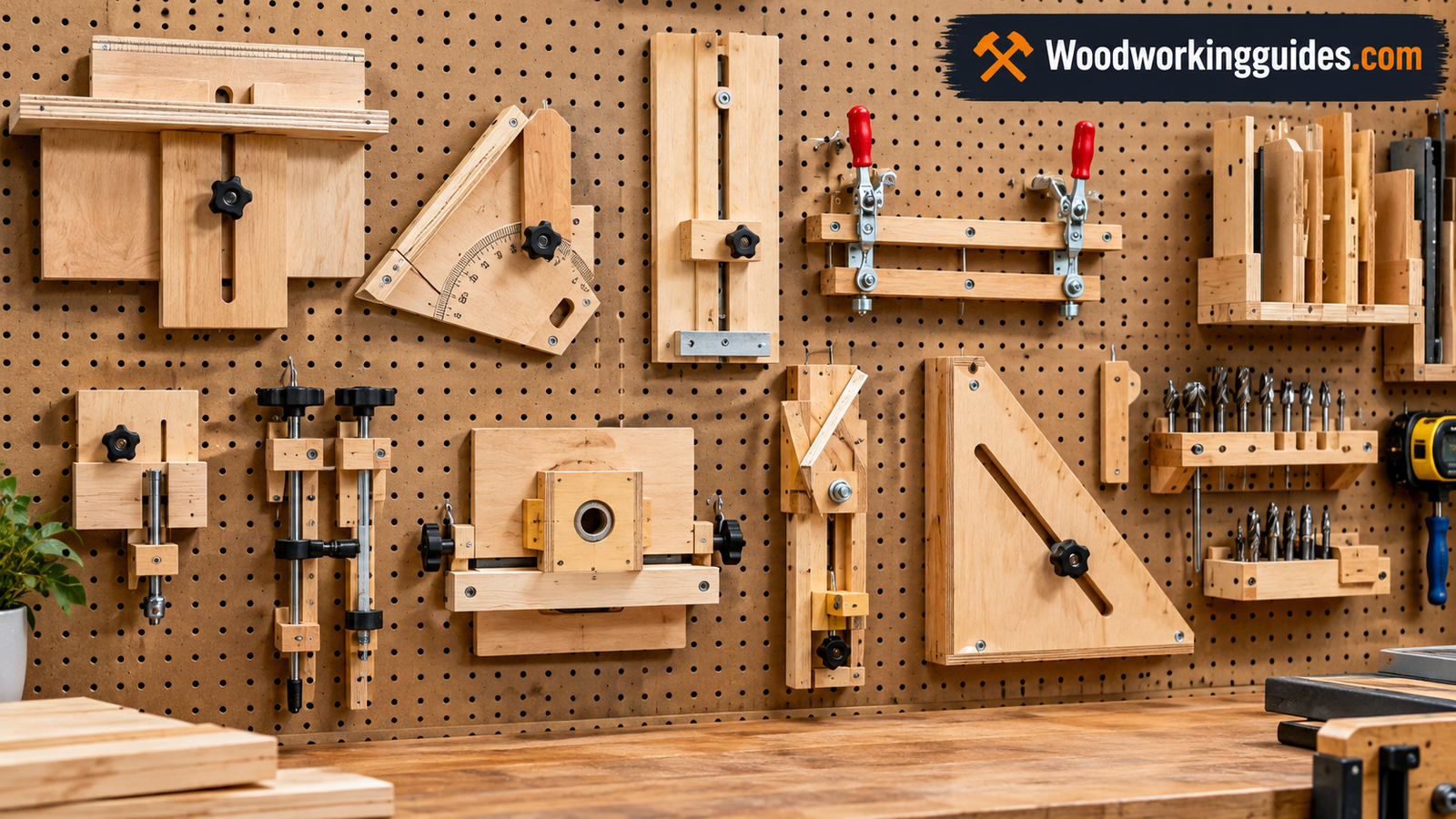
Walk into almost any serious woodshop and you will notice something curious. Tucked behind the tool cabinet, hanging from pegboard hooks, and stacked beside the table saw are odd-looking contraptions made from scrap plywood, hardwood runners, and a surprising number of clamps. Nobody sells most of them at a big-box store, yet the owner would sooner lose a favorite chisel than part with them. Those contraptions are jigs, and they are the quiet reason experienced woodworkers can turn out the same accurate cut, hole, or joint again and again without sweating over it.
If you are new to the craft, the word can sound intimidating, as if it belongs to a secret vocabulary. It does not. A jig is just a helper: a device that holds your work, guides your tool, or both, so the result no longer depends on steady hands and perfect eyesight. In this guide we will walk through exactly what a jig is, how it differs from similar terms, why it matters, and which types deserve a place in your shop. If you are still getting oriented with the broader hobby, our primer on what woodworking is is a friendly place to start, and how to start woodworking with no experience covers the first steps.
1. What a Jig Actually Is
In woodworking, a jig is a custom-made or purpose-built device that controls the position or movement of a tool or workpiece. That is the whole definition, and everything else is variation on the theme. When you clamp a straight board to a sheet of plywood and run a circular saw along it, you have just used a jig. When you screw two fences together at a right angle and slide a board against them to cut a perfectly square end, you have used one again. The goal is always the same: take a task that is tricky to do freehand and turn it into something predictable.
The reason jigs exist comes down to human limits. Our hands wobble, our eyes drift off a pencil line, and our attention fades after the fortieth repetitive cut. A jig removes those variables by building the accuracy into the device itself. Once the jig is set up correctly, anyone can use it and get the same result. That is why it is often said that a jig transfers skill from the operator to the tool. You invest effort once, while building it, and then collect the payoff every time you use it.
Jigs come in nearly every size and level of sophistication. Some are nothing more than a block of wood used as a stop. Others are elaborate sleds with adjustable fences, hold-downs, and measuring scales. Many are shop-made, meaning the woodworker built them from scraps to suit a specific need. Others are manufactured and sold in kits, such as pocket-hole systems and dovetail templates. Both count, and both do the same job.
A simple way to remember it
Think of a jig as a guide rail for your hands. Trains do not wander because the track decides where they go. A jig works the same way for a saw blade, router bit, or drill bit: it decides where the tool goes, and you supply the power and judgment. If you want a deeper look at the broader family of tools these devices support, our overview of the best woodworking tools shows what a well-rounded shop looks like.
Want to see what ready-made jigs and guides look like? Browse popular woodworking jigs on Amazon.
Shop Woodworking Jigs2. Jig vs Fixture vs Template vs Guide
Woodworkers throw several similar words around, and the terms overlap in everyday conversation. In a hobby shop nobody will correct you for calling a sled a jig or a fixture. Still, understanding the traditional distinctions helps you read plans, watch tutorials, and shop for the right product without confusion.
The classic distinction is that a jig guides the tool, while a fixture holds the work. A drilling guide that sits on a board and tells the bit where to go is a jig. A clamping setup that holds a workpiece at a set angle so you can sand it is a fixture. Many real-world devices do both at once, which is why the words blur. A template, meanwhile, is a pattern you trace or follow, usually with a router and a bearing-guided bit, to copy a shape repeatedly.
| Term | What It Does | Common Example |
|---|---|---|
| Jig | Guides the tool or controls its movement relative to the work | Pocket-hole jig, tapering jig, crosscut sled |
| Fixture | Holds or positions the workpiece securely | Sanding fixture, assembly clamp block |
| Template | Provides a shape to copy with a pattern-following bit | Plywood chair-leg pattern for a router |
| Guide | Provides a straight or curved reference edge for a tool | Straightedge for a circular saw or router |
| Stop block | Sets a repeatable length or position | Block clamped to a miter saw fence |
Do not get hung up on vocabulary. If you tell a fellow woodworker you built a jig to cut tapered legs, they will understand immediately. What matters is the idea behind all these terms: make the setup carry the precision, so the person does not have to.
Need layout and marking tools to make your jigs accurate? Check out squares and measuring gear.
Shop Squares and Marking Tools3. Why Woodworkers Use Jigs
It is fair to ask why anyone would spend an afternoon building a contraption when they could simply make the cut. The answer reveals itself the first time you need ten identical parts. Without a jig, each piece is a fresh chance for error. With a jig, the tenth piece matches the first. Repeatability is the headline benefit, but it is far from the only one.
Accuracy you can count on
A good jig bakes in square corners, consistent angles, and exact spacing. Even seasoned craftspeople miss a pencil line by a hair, and a hair adds up when parts have to fit together. A jig that locks the geometry in place turns a hopeful cut into a certain one.
Speed on repetitive work
Marking, measuring, and double-checking each part takes time. When a jig does the positioning, you simply load the piece, make the cut or drill the hole, and move on. For projects with many identical parts, such as cabinet doors, drawer boxes, or a set of dining chairs, that time savings is enormous.
Safer operation
Some of the most important jigs exist purely for safety. A push block keeps your fingers away from a spinning blade. A sled lets you cut a small piece without holding it in your bare hand. A featherboard keeps stock pressed against a fence so it cannot kick back. These simple devices have prevented more injuries than most people realize.
Access to techniques that would otherwise be hard
Certain tasks are simply impractical without a jig. Cutting a perfect circle with a router, drilling a straight hole at a compound angle, or making a clean tenon on a table saw all become approachable with the right guide. Jigs let hobbyists attempt joinery and shaping that once demanded years of practice.
Pros of Using Jigs
- Repeatable, consistent results
- Improved safety around blades and bits
- Faster work on multiple parts
- Lower learning curve for tricky joints
- Cheap when built from scrap
Cons of Using Jigs
- Building takes time up front
- A sloppy jig repeats sloppy results
- Storage space can add up
- Some are single-purpose
- Need periodic checking for wear
Safety gear and push blocks pair perfectly with every jig. See what is available.
Shop Push Blocks and Safety Gear4. The Main Types of Jigs
Jigs are usually grouped by the tool or task they serve. Once you see the categories, the whole landscape becomes much easier to navigate. Each category tends to solve a specific kind of problem, from cutting and routing to drilling, clamping, and sharpening. Here is a quick overview before we dive into each group in detail.
| Category | Typical Jigs | Main Benefit |
|---|---|---|
| Table saw | Crosscut sled, tapering jig, tenoning jig, miter sled | Square, repeatable cuts and safer small-part handling |
| Router | Circle jig, template guides, mortising jig, edge guides | Perfect curves, matching parts, clean joinery |
| Drilling | Pocket-hole jig, doweling jig, shelf-pin jig, drill guide | Straight, evenly spaced holes |
| Joinery | Dovetail jig, box-joint jig, mortise-and-tenon jig | Tight, strong joints with less skill |
| Saw support | Miter saw stop, band saw resaw fence, circle-cutting jig | Consistent lengths and clean curves |
| Clamping and assembly | Corner clamps, panel-glue-up cauls, assembly squares | Square, flat, gap-free assemblies |
| Hand tool | Sharpening guide, bench hook, shooting board, planing stop | Consistent edges and safer hand work |
Notice that some jigs appear in more than one category. A pocket-hole jig is both a drilling guide and a joinery system. A shooting board is a hand-tool device that does the same job as a precision crosscut sled. Do not worry about neat labels. Think instead about the problem you want to solve, and the right jig will usually reveal itself.
Looking for a wide selection of jig kits and systems in one place?
Browse Jig Kits5. Table Saw Jigs
If there is one tool that rewards jigs more than any other, it is the table saw. The saw itself is powerful and unforgiving, and the stock sits on a flat surface, which makes it ideal for sleds and guides. Many woodworkers would argue that a table saw without a few good jigs is only half a tool. If you are shopping for one, our guides on the best table saw for woodworking and how to choose a table saw will help you narrow the options.
The crosscut sled
The crosscut sled is often the first jig a woodworker builds, and for good reason. It rides in the miter slots and carries the workpiece past the blade against a fence set at a true ninety degrees. The result is a clean, square cut that is far more accurate than the stock miter gauge. It also supports small pieces that would be dangerous to hold by hand, and it catches the offcuts so they do not fly back at you.
The tapering jig
Tapered legs give furniture a light, elegant look, but cutting them freehand is a recipe for uneven results. A tapering jig holds the leg at a fixed angle against the fence and lets you cut identical tapers on all four sides. Adjustable versions let you dial in different angles for different projects.
The tenoning jig
A tenoning jig stands the workpiece on end and guides it vertically past the blade so you can cut tenons with clean cheeks and shoulders. Combined with a mortise, it forms one of the strongest joints in woodworking. If you want to understand how the pieces fit together, our guide to wood joinery tools explained is a helpful companion.
Dado and rabbet helpers
Cutting grooves and ledges is routine work on a table saw. A good dado setup and a zero-clearance insert make those cuts cleaner, while an auxiliary fence helps with a rabbet. These small additions are technically jigs too, and they dramatically improve the finish of the cut.
Featherboards, push sticks, and hold-downs
Not every jig makes a cut more accurate. Some simply keep you safe. A featherboard presses stock against the fence, a push stick moves it through the blade, and a hold-down keeps it flat against the table. They cost almost nothing to build and should live permanently beside your saw.
Upgrade your table saw setup with blades, inserts, and sled hardware.
Shop Table Saw Accessories6. Router Jigs and Templates
The router is the most jig-friendly handheld tool ever invented. Because the bit spins in a fixed position relative to the base, you can steer it with an edge guide, a template, a bushing, or a pivot pin and produce shapes that would be nearly impossible by hand. If you are curious about what the tool can do in general, read our explainer on what a woodworking router is used for, and see our roundup of the top wood router picks if you are ready to buy.
Circle-cutting jigs
A circle jig is little more than a strip of plywood with a pivot pin at one end and the router mounted at the other. Set the distance from the pin to the bit, and the router sweeps a perfect arc. This is how woodworkers cut round tabletops, clock faces, and decorative inlays with absolutely clean edges.
Template routing
Template routing is a cornerstone technique for production work. You make one carefully shaped template from MDF or plywood, attach it to your workpiece, and run a pattern bit with a top or bottom bearing along its edge. Every piece that follows is a perfect copy. Chair parts, curved cabinet doors, and guitar bodies are routinely made this way.
Mortising jigs
A mortising jig guides the router in a straight line between stops so you can cut rectangular mortises of consistent width and depth. Some designs are simple fence-and-stop arrangements, while others are elaborate box-style jigs with built-in clamps. Either way, they make mortise-and-tenon joinery far more accessible to beginners.
Edge guides and straightedge guides
The simplest router jig is a clamped straightedge. Clamp a straight board across your work, run the router base along it, and you have a clean, straight dado or groove. For shelf supports and cabinet joinery, this basic setup is hard to beat.
Router table fences and sleds
On a router table, the fence is itself a jig. Add a miter sled for end-grain work, a tall auxiliary fence for raised panels, or a sacrificial fence for stopped cuts, and you can handle a huge range of tasks. Many woodworkers find that a router table with a few simple jigs replaces several specialty machines.
Pair your router with the right bits, bushings, and edge guides.
Shop Router Accessories7. Drilling and Joinery Jigs
Drilling a hole straight and in the right spot sounds easy until you try it freehand on a visible furniture part. A tiny angle error can cause a dowel to bind or a screw to break through the face of a board. Drilling and joinery jigs take that anxiety away, and they are among the most popular store-bought jigs for good reason. Pair them with a reliable drill, and our look at the best cordless drill for woodworking can guide your pick.
Pocket-hole jigs
A pocket-hole jig clamps to your board and guides a stepped drill bit at a shallow angle, creating a hole for a self-tapping screw that draws two boards together tightly. The joint is quick, strong, and requires almost no clamping, which is why it dominates cabinet building and face-frame construction. The holes can be hidden or plugged, and the whole process takes only seconds.
Doweling jigs
Dowels are an old and reliable way to align and strengthen a joint. A doweling jig holds a bushing over the exact center of the board edge so the holes in both mating pieces line up perfectly. Self-centering versions are especially friendly to beginners.
Shelf-pin jigs
If you have ever built a bookcase with adjustable shelves, you know how tedious it is to drill dozens of evenly spaced holes. A shelf-pin jig is a perforated template that guides the bit at precise intervals, ensuring every shelf sits level.
Dovetail and box-joint jigs
Dovetails are the signature of fine drawer construction, and a dovetail jig lets you rout them with a router in minutes rather than hand-cutting them over an hour. Box-joint jigs, typically used on a table saw or router table, produce interlocking fingers that are strong and attractive. Both transform what used to be advanced joinery into something a motivated beginner can try.
Drill guides and angle blocks
A drill guide is a simple block that keeps the bit square to the surface. For compound angles, such as the splayed legs of a stool, an angle block or tilting jig keeps the drill at the exact slope you need. These are some of the easiest jigs to make from scrap.
| Jig | Best For | Skill Level |
|---|---|---|
| Pocket-hole jig | Cabinets, face frames, quick assemblies | Beginner |
| Doweling jig | Edge joints, aligned panels, light frames | Beginner |
| Shelf-pin jig | Bookcases and adjustable shelving | Beginner |
| Box-joint jig | Boxes, drawers, toolboxes | Intermediate |
| Dovetail jig | Drawers and fine casework | Intermediate |
Ready to try pocket holes, dowels, or dovetails? Compare popular drilling and joinery jigs.
Shop Pocket-Hole Jigs8. Miter Saw, Band Saw, and Sanding Jigs
Beyond the table saw and router, other machines in the shop benefit from a good guide. Miter saws, band saws, jointers, and sanders all have their own handy jigs, and many are quick to build. The right helper can turn a decent machine into an impressively accurate one.
Miter saw stops and auxiliary fences
A miter saw is already fast, but a stop block clamped to an extended fence makes it faster and far more repeatable. Set the block once and every piece comes out the same length, which is perfect for picture frames, cabinet face frames, and trim work. An auxiliary fence also supports the workpiece near the blade and reduces tear-out. If you are still choosing a machine, check out our guide to the best miter saw for a home shop.
Band saw jigs
The band saw shines at curves and resawing, and both tasks improve with a jig. A resaw fence with a drift-adjusting pivot helps you slice thick boards into thin veneers. A circle-cutting jig, essentially a pivot pin mounted to a table extension, lets you cut near-perfect discs without a router. A V-block holds round stock steady for crosscutting dowels and spindles.
Jointer and planer helpers
Flattening a board correctly is a foundation skill. Our article on what a jointer does in woodworking explains the basics. A planer sled, which is a flat carrier board with shims to support a twisted workpiece, lets you flatten one face on a planer and is one of the most useful jigs a small shop can own.
Sanding jigs
Sanding often feels like an afterthought, but jigs help here, too. A sanding block with a flat reference keeps edges square. A disc sander jig with a miter slot and a pivot arm produces perfect arcs and angles. Pair them with a quality sander, and the finish improves noticeably. If you are comparing models, see our review of the best random orbital sander.
Add stops, fences, and sanding accessories to your saws and sanders.
Shop Saw and Sanding Accessories9. Clamping, Assembly, and Hand-Tool Jigs
Not every jig lives near a power tool. Some of the most beloved shop helpers are designed for assembly and hand work. They tend to be simple, cheap, and endlessly useful, and they prove that a jig does not need to be complicated to be valuable.
Assembly squares and corner jigs
Gluing up a box or cabinet is stressful because you have a limited window before the glue sets. An assembly square, a rigid right-angle jig, holds the corners at ninety degrees while the glue dries. Corner clamping jigs do the same for frames and boxes. They remove the guesswork and save you from discovering a racked assembly after it is too late.
Cauls and panel glue-up helpers
Cauls are curved or straight strips clamped across a glue-up to keep boards aligned and flat. They counteract the tendency of panels to bow under clamp pressure and are particularly handy when assembling a tabletop or workbench top. Good clamping starts at the workbench, so it helps to have a solid one; see our guides to the best woodworking workbench and the best portable woodworking workbench.
Bench hooks and shooting boards
A bench hook is a flat board with a cleat on each side, one that hooks over the front of your bench and the other that backs a workpiece while you saw. A shooting board holds a piece at a perfect angle so you can trim its end with a hand plane. Both are timeless hand-tool jigs, and both are easy to make in an afternoon. If you are weighing the merits of working by hand, you might enjoy our comparison of hand tools vs power tools for woodworking.
Sharpening guides
A sharp edge is the foundation of every clean cut, and a sharpening guide holds a chisel or plane iron at a consistent bevel angle on the stone. Beginners often struggle to hold a steady angle by hand, and a simple honing guide solves the problem. Pair it with a good set of chisels, and see our picks for the best chisel set for beginners.
Shop clamps, corner squares, and sharpening guides for your bench.
Shop Clamps and Guides10. Materials and Tools for Building Jigs
One of the happiest discoveries for new woodworkers is that most jigs cost almost nothing to build. They are made from scraps, offcuts, and basic hardware. What matters is not how expensive the materials are but how flat, stable, and accurate they are. A warped jig is worse than no jig at all.
Plywood and MDF
Good-quality plywood is the workhorse of jig building. Baltic birch is especially popular because it is flat, has uniform layers, and holds screws well. MDF is another favorite because it is dead flat and machines cleanly, making it ideal for router templates. If you want to understand more about plywood grades, our guide to the best plywood for a workbench top covers the same stability qualities you will want in a jig.
Hardwood runners and fences
Sleds and guides that ride in a slot need runners that fit snugly without binding. Hardwood such as maple or oak is a good choice because it wears slowly. Fences are often made from straight, stable hardwood or from a stack of plywood laminated together.
Hardware that pays off
A small collection of hardware makes jigs far better. T-track lets you slide stops and hold-downs along a rail. Toggle clamps hold work quickly and securely. Threaded inserts and knobs allow adjustments without stripping wood. Self-adhesive measuring tapes help with repeatable settings. None of these are expensive, but each can elevate a basic jig to a professional-quality helper.
Glue, screws, and finish
Use glue and screws together for strong, lasting joints. Sealing the jig with a coat of finish helps it resist humidity swings, which keeps it flat. A little paste wax on sliding surfaces reduces friction and makes the jig feel smooth to use.
| Material | Best Use | Why It Works |
|---|---|---|
| Baltic birch plywood | Sleds, bases, fences | Flat, strong, holds fasteners well |
| MDF | Router templates, patterns | Very flat and easy to shape |
| Hard maple or oak | Runners, stops | Wears slowly and stays straight |
| T-track and toggle clamps | Adjustable stops, hold-downs | Fast setup and secure hold |
| Hardboard | Thin templates, spacers | Smooth, stable, inexpensive |
As you set up your space, our guide to setting up a beginner woodshop offers help planning where jigs, materials, and tools will live. A little storage planning goes a long way, because jigs you cannot find are jigs you will never use.
Stock up on T-track, toggle clamps, and measuring tapes for your next jig build.
Shop Jig-Building Hardware11. Buy vs Build and Your First Jigs
Should you buy a jig or build one? The honest answer is that both options have a place in a healthy shop. Store-bought jigs offer polished engineering and quick setup, while shop-made jigs offer customization and low cost. Many experienced woodworkers use a mix of the two.
Why Build Your Own
- Costs little, often just scrap
- Fits your exact tools and needs
- Teaches valuable shop skills
- Easy to modify or rebuild
- Great for one-off tasks
Why Buy Ready-Made
- Precision-machined and tested
- Ready to use right away
- Good for complex systems like dovetails
- Often includes instructions and support
- Saves build time on tight schedules
Five jigs worth making first
- Crosscut sled: the single most useful table saw jig for accuracy and safety.
- Push blocks and sticks: cheap, quick, and a permanent safety upgrade.
- Bench hook: a beginner-friendly project that makes hand sawing easier.
- Circle-cutting jig: a simple router jig that opens up round projects.
- Tapering jig: perfect for furniture with elegant tapered legs.
Once you have a handful of jigs under your belt, you may discover that the skill is worth sharing. Some makers even turn their designs into a small side income, which we explore in our guides on how to sell woodworking plans online and how to start a woodworking business.
Not ready to build? Compare ready-made sleds, guides, and jig systems.
Shop Ready-Made Sleds12. Safety, Accuracy, and Common Mistakes
Jigs are meant to make your work safer and more accurate, but a badly designed or carelessly used jig can do the opposite. Treat every jig as a tool in its own right, with its own rules and its own limits. A few good habits keep you out of trouble and keep your cuts clean.
Safety first
- Keep hands clear: design jigs so your fingers never sit in line with a blade or bit.
- Use hold-downs: a workpiece that lifts or shifts during a cut is dangerous.
- Add blade guards or covers: a sled should shield the blade at the back of the cut.
- Wear eye and ear protection: jigs do not reduce noise or flying chips.
- Never rush a setup: take time to check clearances before turning on the power.
Accuracy habits
Always test a new jig on scrap before trusting it with good lumber. Use the five-cut method or a reliable square to verify that sleds are truly square. Check for wear on runners and fences, because small gaps grow quickly. Label your jigs with their settings or purpose so you do not have to rediscover how to use them six months later.
Common mistakes to avoid
- Building from warped or damp wood, which leads to a jig that moves out of true.
- Skipping the test cut and discovering errors on a finished part.
- Overcomplicating the design when a simple block would do.
- Letting sawdust build up on runners and bearing surfaces.
- Forgetting to recheck angle stops after moving or storing the jig.
A jig is a promise of repeatability, and that promise only holds if the jig stays accurate. A short check before each important project is a small price for confidence in the results.
Protect your eyes, ears, and lungs while you work. Browse shop safety essentials.
Shop Shop-Safety GearFrequently Asked Questions About Woodworking Jigs
What is a jig in woodworking in simple terms?
A jig is a device that guides a tool or holds a workpiece so you can make accurate, repeatable cuts, holes, or joints without relying on freehand skill. It can be as simple as a block of wood or as elaborate as a precision sled.
What is the difference between a jig and a fixture?
Traditionally, a jig guides the tool, while a fixture holds the work. In everyday woodworking the terms overlap, and many devices do both jobs at once, so most people use the word jig for either.
What is the most useful jig for a beginner?
Most woodworkers recommend a crosscut sled for the table saw, since it improves accuracy and safety at the same time. A pocket-hole jig is also popular for beginners because it makes strong joints quickly.
Are shop-made jigs as good as store-bought ones?
They can be, as long as they are built from flat, stable materials and tested for accuracy. Complex systems such as dovetail jigs are often easier to buy, while sleds, stops, and templates are easy to make yourself.
What materials are best for making jigs?
Baltic birch plywood and MDF are the most common choices because they are flat and stable. Hardwoods like maple work well for runners, and hardware such as T-track and toggle clamps adds adjustability.
Do jigs make woodworking safer?
Many do. Push blocks, sleds, and featherboards keep your hands away from blades and hold the workpiece firmly. However, a poorly built jig can create new hazards, so design and test them carefully.
What is a router jig used for?
Router jigs guide the router to cut circles, copy templates, make mortises, or produce straight grooves. They allow a handheld tool to deliver precise, repeatable shapes that would be difficult freehand.
What is a pocket-hole jig?
A pocket-hole jig guides a stepped drill bit at a shallow angle to create a hole for a special screw. The screw pulls two boards tightly together, making a quick and strong joint for cabinets and frames.
How do I make sure my jig is accurate?
Build it from flat materials, assemble it carefully, and test it on scrap. For sleds, use the five-cut method or a trusted square to verify that the fence is perfectly square, then recheck periodically.
Can I use a jig with hand tools?
Yes. Bench hooks, shooting boards, and sharpening guides are all jigs designed for hand tools. They help you saw, plane, and sharpen with greater consistency.
How many jigs does a woodworker really need?
There is no magic number. Start with a few that solve your most frequent problems, such as a crosscut sled and push blocks, and add more as new projects demand them.
Where should I store my jigs?
Hang them on a pegboard or French cleat wall, or store flat ones on a shelf near the tool they serve. Labeling them helps you find the right one quickly and keeps them from warping.
Conclusion: Let a Jig Do the Hard Part
A jig is one of the simplest ideas in woodworking and one of the most powerful. By letting a well-made guide control the position of your tool or workpiece, you trade a bit of upfront effort for a lifetime of accurate, repeatable, and safer work. Whether you start with a humble bench hook, a crosscut sled, or a ready-made pocket-hole system, every jig you add makes the next project a little easier and a lot more satisfying.
Start small. Pick the task that frustrates you most, build or buy a jig to solve it, and notice how much more confident your cuts feel. Before long, you will have your own collection of shop helpers, each with its own story, and you will understand why seasoned woodworkers treat them like old friends.
Ready to bring more accuracy into your shop? Explore jigs and guides on Amazon.
Shop Jigs and Guides
Pingback: Best Clamps for Woodworking: 11 Top Sets