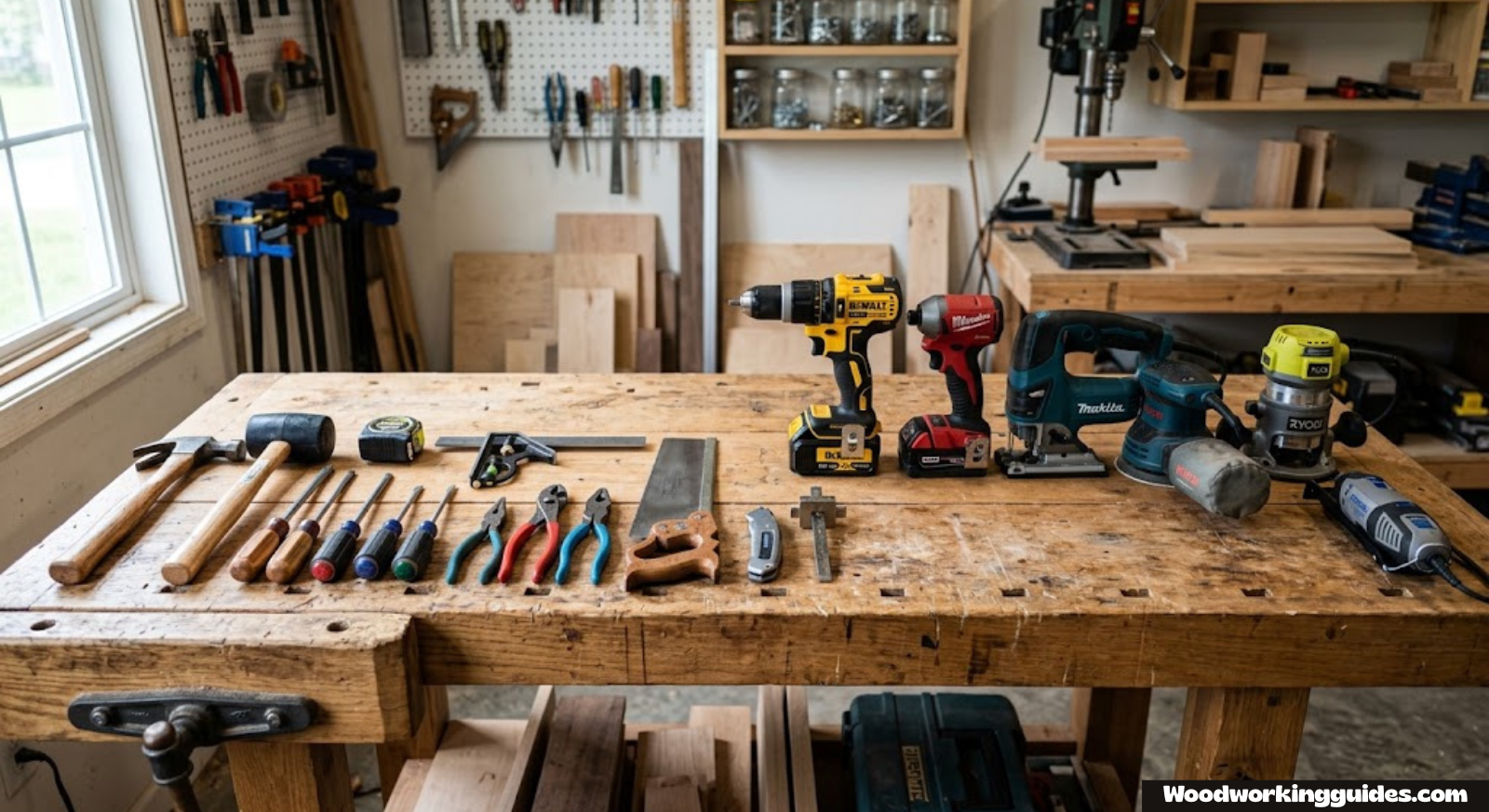
Hand Tools vs Power Tools for Woodworking: The Complete Comparison Guide
Every woodworker eventually asks the same question: should I reach for the chisel or the router? Here’s a full, practical breakdown of precision, cost, safety, speed, and skill so you can build a shop — and a workflow — that actually fits how you work.
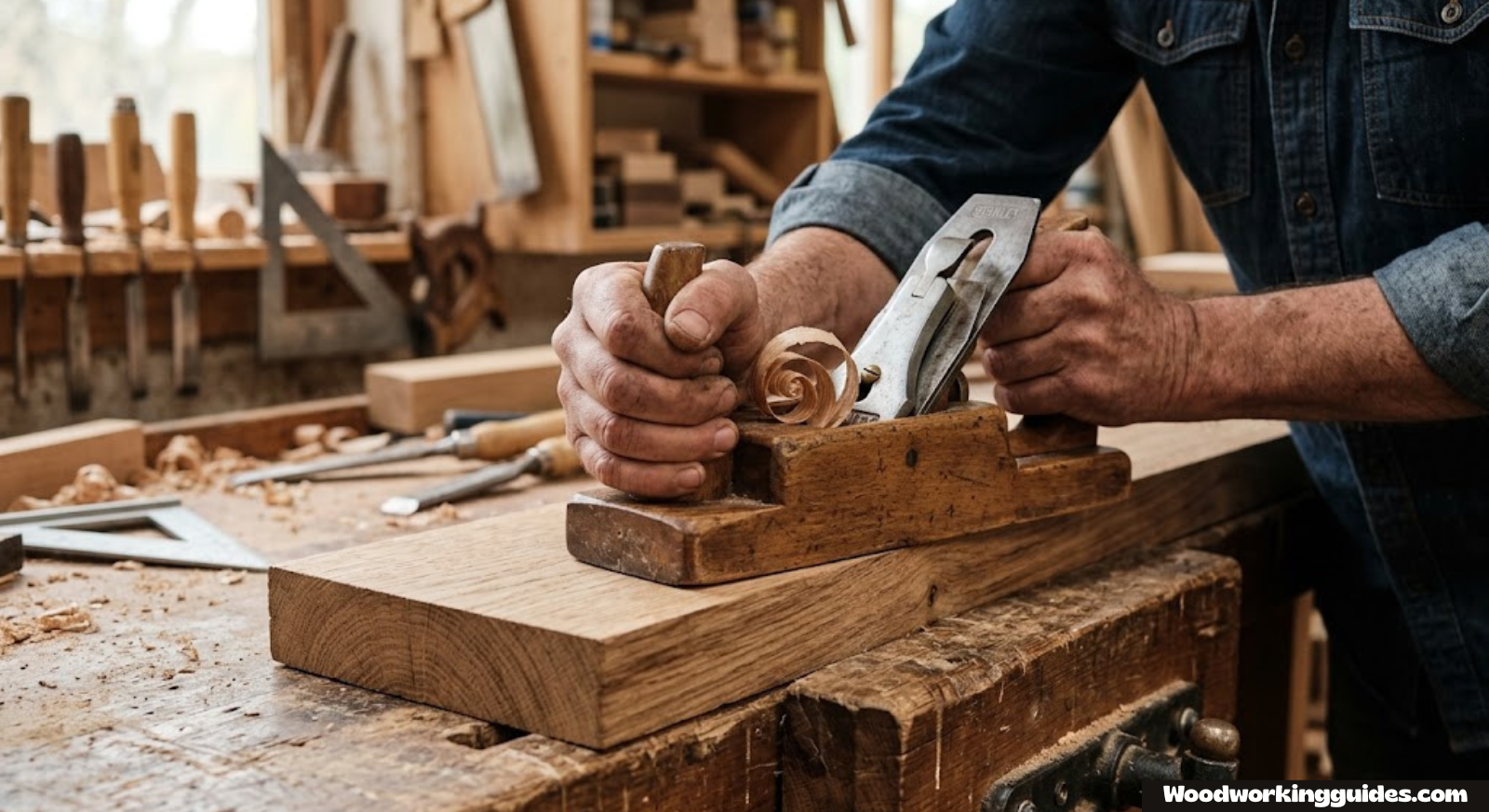
Why the Hand Tools vs Power Tools Debate Still Matters
Walk into any two woodshops and you’ll find two completely different personalities. One is quiet, smells like fresh shavings, and is filled with chisels, hand planes, and saws hanging on a wall like a painter’s brushes. The other hums with motors, dust collection hoses snake across the floor, and a table saw dominates the center of the room. Both shops build beautiful furniture. Both are “correct.” That’s exactly why the hand tools vs power tools question refuses to go away — it isn’t really about which tool is objectively better, it’s about which approach fits your project, your patience, your budget, and the kind of woodworker you want to become.
This guide breaks the decision down into the categories that actually matter in practice: precision, speed, learning curve, cost, safety, noise and dust, portability, and project suitability. Instead of declaring a winner, the goal is to help you build a shop — and a skill set — that uses each tool type where it genuinely shines. If you’re just getting your bearings, our overview of the best woodworking tools is a good companion read alongside this one.
Whether you’re outfitting a first apartment workshop or expanding a garage shop that’s outgrown its extension cords, understanding the real trade-offs between muscle-powered tools and motorized ones will save you money, frustration, and more than a few ruined boards.
It also helps to understand why this question feels so loaded in the first place. Woodworking culture has, at various points, treated hand-tool purism and power-tool efficiency as competing identities — one associated with tradition and patience, the other with productivity and modern shop practice. In reality, the divide is much less philosophical than the internet forums make it sound. Furniture makers who sell for a living almost always use power equipment for the bulk of their work simply because time is money, while hobbyists who woodwork as a form of relaxation often gravitate toward the quieter, slower rhythm of hand tools precisely because the process, not just the outcome, is the point. Neither motivation is wrong, and understanding your own “why” before you buy tools will save you from stocking a shop that doesn’t match how you actually like to work.
There’s also a practical reason to get this decision right early: tool purchases compound. A beginner who buys a full stationary power-tool shop before learning basic hand skills often struggles with tear-out, poor joinery fit, and machine setups they don’t fully understand. A beginner who buys only hand tools and skips power equipment entirely can spend hours on tasks that would take minutes with the right machine. The sections below are built to help you avoid both mistakes.
What Are Hand Tools in Woodworking? Definition
Hand tools are woodworking implements powered entirely by the user’s own effort — no motor, no battery, no cord. This category includes chisels, hand planes, backsaws, marking gauges, mallets, spokeshaves, and card scrapers. They trace their design lineage back centuries, and in many cases the tools sold today are barely different from versions used by 18th-century joiners, just made with better steel and tighter tolerances.
What defines the hand-tool philosophy isn’t the absence of technology; it’s the direct feedback loop between the woodworker and the material. When you pare a dovetail with a sharp chisel, you feel the grain change under the edge in real time and can adjust pressure instantly. That tactile feedback is the entire appeal — and also the entire learning curve, because it requires developing hand-eye coordination and an intuitive sense of wood grain that no jig can replace.
Common Hand Tool Categories
- Cutting tools: hand saws, backsaws, coping saws
- Shaping tools: chisels, gouges, spokeshaves, drawknives
- Smoothing tools: bench planes, block planes, card scrapers
- Layout tools: marking gauges, try squares, marking knives
- Joinery tools: mortise chisels, dovetail saws
If you’re building a hand-tool kit from scratch, our guide to a best chisel set for beginners covers exactly which sizes and steel types are worth the investment, and our wood joinery tools explained article dives deeper into how these tools work together to cut traditional joints.
One thing that surprises a lot of newcomers is how much of hand-tool woodworking is actually about tool preparation rather than tool use. A hand plane straight out of the box is rarely ready to perform well — the sole often needs flattening, the blade needs honing to a consistent angle, and the chip breaker needs to be set correctly to avoid tear-out. This “tuning” step is unfamiliar territory for anyone coming from a power-tool background, where a blade or bit is simply installed and used. It’s also part of why hand tools develop such a loyal following: once a plane or chisel is properly tuned, it performs dramatically better, and that improvement feels earned in a way that swapping a factory-sharp router bit never quite does.

Starter Pick: A quality bevel-edge chisel set is the single most useful hand-tool investment for a new woodworker — used for everything from cleaning joints to rough shaping.
Check Price on AmazonWhat Are Power Tools in Woodworking? Definition
Power tools use an electric motor — corded or battery-driven — to do the physical work that a hand tool would otherwise ask of your arm. Table saws, routers, cordless drills, random orbital sanders, and miter saws fall into this group. Their defining trait is repeatable output: a router bit spins at the same speed whether you’re tired or fresh, and a table saw’s rip fence holds a dimension far more consistently than a hand-guided rip cut ever could.
Power tools didn’t replace hand tools so much as they industrialized the repetitive parts of woodworking. Ripping a 16-foot board to width by hand is a genuine workout; on a table saw it’s a fifteen-second cut. That shift in labor is the whole reason production shops moved to power equipment in the first place, and it’s why most modern hobbyist shops use a blend of both.
Common Power Tool Categories
- Stationary machines: table saws, band saws, jointers, planers
- Handheld power tools: routers, circular saws, jigsaws, drills
- Sanding tools: random orbital sanders, belt sanders
- Cutting tools: miter saws, track saws
For anyone assembling a power-tool arsenal, start with our roundups of the best table saw for woodworking and the top wood router picks — these two machines alone handle a huge share of everyday shop tasks.
It’s worth noting that “power tool” covers an enormous range of investment levels. A cordless drill and a cabinet-grade table saw are both power tools, but they sit at opposite ends of the price and complexity spectrum. Handheld power tools — drills, routers, sanders, jigsaws — tend to be affordable, portable, and forgiving of small workshop footprints, which is why they’re usually the first power tools a beginner owns. Stationary machines — table saws, jointers, planers, band saws — represent a bigger commitment in both dollars and floor space, but they’re also what unlocks true production-level efficiency, letting you dimension rough lumber accurately and repeatably instead of fighting with hand tools to achieve the same flatness and consistency.

Shop Essential: A cordless drill/driver is usually the first power tool a woodworker owns, and it earns its keep on nearly every project from cabinets to outdoor furniture.
Check Price on AmazonPrecision and Control: Which Actually Wins?
This is where the debate gets genuinely interesting, because the honest answer is: it depends on the operation, not the tool category. A well-tuned hand plane, guided by a skilled hand, can take a shaving thinner than a human hair and produce a glassy surface no sandpaper grit can match. But ask that same hand plane to hold a perfectly parallel 3/4-inch thickness across a four-foot board, and a powered thickness planer will win every time, because it references off a fixed bed rather than human muscle memory.
Power tools excel at repeatable precision — the same cut, the same depth, the same angle, a hundred times in a row, thanks to fences, stops, and jigs. Hand tools excel at responsive precision — adjusting a cut in real time to compensate for grain reversal, a slightly proud joint, or a subtle taper that a machine setup could never anticipate.
Hand Tools — Precision Strengths
- Feel-based adjustments mid-cut
- No tear-out on figured or reversing grain when used correctly
- Excellent for fine-tuning joinery fit
Power Tools — Precision Strengths
- Consistent, repeatable dimensions
- Fences and stops remove human error
- Better for identical parts in batches
In practice, most experienced woodworkers use power tools to get a piece close to final dimension quickly, then switch to hand tools for the last few thousandths — fitting a drawer front, paring a tenon shoulder, or smoothing a glue line. That combination consistently produces better results than either approach alone.
Grain reversal is a good example of where this plays out clearly. Figured woods like curly maple or quilted walnut change grain direction constantly across a single board, which means a powered planer set to a standard depth of cut will tear out chunks no matter how sharp the blades are. A hand plane with a tight mouth, a high cutting angle, and a properly set chip breaker can glide across that same reversing grain because the user can sense resistance building and respond instantly — slowing down, skewing the tool, or lightening the cut before tear-out happens. That responsiveness is simply not something a fixed-speed, fixed-depth machine can replicate, which is why high-end furniture makers still keep a well-tuned smoothing plane within arm’s reach even in fully powered shops.
Speed and Efficiency in the Shop
There’s no honest way to argue that hand tools are faster than power tools for stock removal. Ripping a rough board to width, flattening a cupped panel, or cutting a dozen identical shelf dadoes is dramatically quicker with a table saw, planer, or router than with a hand saw and jack plane. If your goal is production output — say, building a run of matching bookshelves — power tools aren’t just convenient, they’re the only realistic option for a hobbyist working evenings and weekends.
That said, speed isn’t the only measure of efficiency. Setting up a table saw jig for a single one-off cut can sometimes take longer than just making that cut with a hand saw. Hand tools also skip the “gearing up” overhead entirely: no dust collection to switch on, no push blocks to grab, no ear protection to put on. For quick, small-scale tasks, grabbing a chisel is often faster in total elapsed time than powering up a router table.
| Task | Faster With | Why |
|---|---|---|
| Ripping rough lumber to width | Power (table saw) | Motor removes bulk material in seconds |
| Cutting a single dovetail | Hand tools | No jig setup time; direct control |
| Flattening a large panel | Power (planer/jointer) | Consistent thickness across long stock |
| Trimming a proud tenon | Hand tools | Fine, feel-based adjustment |
| Drilling repeated pilot holes | Power (cordless drill) | Speed and consistent depth with a stop collar |
If your shop time is limited, leaning on power tools for bulk work and saving hand tools for detail work is the most time-efficient strategy — a philosophy covered in more depth in our guide to setting up a beginner woodshop.
It’s also worth separating “efficient” from “fast.” A router table set up with a fence and stop blocks can produce twenty identical dado cuts almost as quickly as one, which makes it dramatically more efficient for batch work even though the very first cut might take longer to set up than doing it by hand. Hand tools flip that equation: the first cut and the twentieth cut take roughly the same amount of time and effort, because there’s no setup to amortize. If you only need one of something, that consistency of effort is often the more efficient choice. If you need many, the power tool’s setup cost pays for itself almost immediately.

Efficiency Booster: A random orbital sander turns hours of hand-sanding into minutes without leaving cross-grain scratches.
Check Price on AmazonLearning Curve and Skill Development
Hand tools ask more of you upfront. Sharpening alone is a skill most beginners underestimate — a dull chisel or plane iron will fight you, tear the grain, and make you think the tool (or you) is the problem when it’s usually just the edge. Expect a genuine investment of time before hand-tool work starts to feel smooth rather than frustrating. The payoff is that the skills transfer directly: once you understand grain direction, cutting angles, and edge geometry, every hand tool you pick up afterward makes more sense.
Power tools have a gentler entry curve for getting a usable result, but a steeper curve for getting a safe and precise result. A beginner can rip a reasonably straight board on a table saw in their first session, but understanding kickback, blade height, feather boards, and push-stick technique takes deliberate study — skipping that step is how most serious shop injuries happen. Our guide on how to choose a table saw covers the safety features worth prioritizing for new users.
Realistically, most woodworkers develop both skill sets in parallel rather than mastering one before touching the other. Learning to sharpen a chisel properly will also make you a better table saw user, because you’ll understand cutting-edge geometry and tear-out prevention either way.
There’s also a psychological difference worth mentioning. Hand-tool mistakes tend to be forgiving — a slightly uneven plane stroke can be corrected with another pass, and a chisel cut that goes slightly off line can often be pared back into shape. Power-tool mistakes are frequently unforgivable in the moment: a board cut a sixteenth of an inch too short on a miter saw is simply too short, full stop. That asymmetry means new woodworkers often build confidence faster with hand tools, where the cost of an early mistake is low, before moving on to machines where precision has to be planned in advance rather than corrected after the fact.
Cost Breakdown: Upfront, Maintenance, and Longevity
On paper, hand tools look cheaper, and for a starter kit they usually are — a few quality chisels, a block plane, and a hand saw can be assembled for a fraction of the cost of a single stationary power tool. But cost comparisons get more nuanced once you factor in time, since hand-tool work trades money for hours, and stationary power tools trade money for speed.
| Category | Typical Hand Tool Cost | Typical Power Tool Cost |
|---|---|---|
| Entry-level starter kit | Low – Moderate | Moderate – High |
| Maintenance | Sharpening stones, occasional replacement | Blades, bits, batteries, motor upkeep |
| Longevity | Decades, often improves with use and tuning | Years, subject to motor wear and obsolescence |
| Resale value | Vintage hand tools often appreciate | Depreciates like most electronics |
Power tools also carry ongoing consumable costs that add up quietly: saw blades, router bits, sanding discs, and replacement batteries. A well-maintained hand plane, by contrast, mostly just needs sharpening — the same iron can last a lifetime with proper care. If budget is your primary constraint, our breakdown of the best woodworking workbench options is worth reading before you buy any tools at all, since a solid, well-built bench is what makes hand-tool work actually usable.
Secondhand markets shift this calculation further in favor of hand tools. Vintage hand planes and chisels from established manufacturers are widely available at flea markets and estate sales, often at a fraction of new retail prices, and many perform beautifully once cleaned up and re-sharpened. Buying a used table saw or jointer carries more risk — motors wear out, alignment can be off, and safety features on older machines may not meet current standards — so beginners generally have more room for error shopping secondhand hand tools than secondhand power equipment. If you do go the used-machine route, budget extra time and a small amount of money for a thorough safety inspection and tune-up before first use.

Value Pick: A compact miter saw delivers accurate crosscuts for a fraction of a full stationary saw setup — great for smaller budgets and shops.
Check Price on AmazonSafety Considerations for Both Tool Types
It’s tempting to assume hand tools are inherently safer because there’s no spinning blade involved, but that’s an oversimplification. Sharp chisels and hand plane irons cause plenty of injuries — usually cuts from tools slipping because they weren’t sharp enough, forcing the user to apply more pressure than control allows. Power tools carry different risks entirely: kickback, blade contact, and dust or noise exposure over time.
Hand Tool Risks
- Cuts from slipping, dull edges
- Repetitive strain from extended use
- Requires constant edge maintenance for safe control
Power Tool Risks
- Kickback on table saws and router tables
- Blade or bit contact injuries
- Long-term hearing and lung exposure
Good practice looks different for each: keep hand tools sharp (a sharp edge is safer than a dull one because it requires less forced pressure) and always cut with the grain direction in mind. For power tools, always use push sticks, blade guards, and hearing/eye protection, and never bypass safety interlocks even for “quick” cuts. Wearing the right shop apron also matters more than most beginners realize — heavy canvas or leather protects against both flying debris and stray edge tools. Our comparisons of the best leather woodworking apron and waxed canvas woodworking apron options can help you pick the right protection for your shop style.
Fatigue is another safety factor that gets overlooked in both categories. Hand-tool work is physically demanding in a slow-building way — hours of sawing or planing can fatigue the forearms and grip, and a tired grip is a less controlled grip, which raises the odds of a slip. Power-tool fatigue shows up differently: it’s mental rather than physical, and it tends to creep in during long sessions when a woodworker starts making “quick” cuts without resetting guards or push sticks because they’ve done the same cut safely fifty times already. Most serious power-tool injuries happen not on the first cut of the day but somewhere in the routine, so treating every cut with the same setup discipline — regardless of how many times you’ve made it before — matters more than any single piece of safety gear.
Noise, Dust, and Workshop Environment
If you’ve ever hand-planed a board next to someone running a router, you already know the environmental difference is night and day. Hand tools are close to silent and produce shavings rather than fine airborne dust — a real consideration if you work in a garage attached to living space, an apartment building, or anywhere neighbors might complain about noise. Power tools, especially routers, planers, and table saws, generate both significant noise (often well above safe unprotected exposure levels) and fine dust that lingers in the air long after the cut is finished.
This is a genuinely underrated reason many urban and apartment-based woodworkers lean more heavily on hand tools: you can dovetail a drawer at 10pm without waking the household, something no router table allows. On the flip side, if you already have a dedicated garage or detached shop with dust collection, this concern mostly disappears, and the efficiency of power tools becomes the deciding factor instead.
Whichever direction you lean, dust management matters for long-term lung health regardless of tool type — hand-tool shavings are less airborne but sanding dust from any source should still be collected or filtered.
Wood species also plays a role here that’s easy to overlook. Some woods, including certain exotic and tropical species, produce dust that’s a known respiratory or skin irritant regardless of whether it’s generated by hand or by machine. If you’re working with those species, a respirator and dust extraction aren’t optional extras — they’re baseline equipment. For most domestic hardwoods and softwoods, though, the noise and volume of dust remain the bigger practical differences between the two tool categories, and they’re usually the deciding factor for anyone woodworking in a shared home or apartment setting.
Portability and Workspace Requirements
Hand tools travel light. A roll of chisels, a block plane, and a small saw fit in a bag and can be used on a portable workbench, a set of sawhorses, or even a kitchen table with the right setup. This makes hand-tool woodworking genuinely accessible to people without a dedicated shop — students, apartment dwellers, and anyone building furniture in shared spaces.
Stationary power tools are the opposite: a table saw needs floor space, clearance on all sides, and usually 120V or 240V circuits that a lot of older garages weren’t wired for. Even “compact” versions still demand a permanent or semi-permanent footprint. If space is tight, our review of the best portable woodworking workbench shows how a folding bench can support both hand-tool work and smaller power tools without dedicating a whole room to woodworking.
| Factor | Hand Tools | Power Tools |
|---|---|---|
| Storage footprint | Small — wall rack or tool roll | Large — dedicated bench or floor space |
| Power requirements | None | Outlets, sometimes dedicated circuits |
| Travel-friendly | Yes — fits in a bag | Limited to handheld models |
| Apartment-suitable | Yes, generally quiet | Often restricted by noise/space |
Climate and storage conditions matter too, and they affect each tool category differently. Hand tools with exposed steel — plane irons, chisel edges, saw plates — are prone to rust in humid garages or basements without regular oiling and careful storage. Power tools face a different set of environmental risks: temperature swings can affect battery performance and lifespan, and dusty environments can clog motor vents and shorten a tool’s working life if it isn’t cleaned out periodically. Neither category is maintenance-free, but the maintenance tasks look different enough that it’s worth planning storage — a dry tool cabinet, a climate-stable corner of the garage — around whichever mix of tools you end up owning.
Best Tool for Each Project: A Practical Breakdown
Rather than picking a side, most experienced woodworkers match the tool to the task at hand. Here’s a practical look at where each category naturally fits.
Best Suited to Hand Tools
- Fine joinery — dovetails, mortise-and-tenon fitting, inlay work
- Small repairs and touch-ups on finished furniture
- Carving, chamfering, and decorative detail
- Any task in a quiet, shared, or dust-sensitive space
Best Suited to Power Tools
- Dimensioning rough lumber — ripping, planing, jointing
- Cutting sheet goods like plywood and MDF
- Repetitive cuts for batch or production work
- Large-scale sanding and surface prep
Joinery in particular benefits from a hybrid approach: many woodworkers rough out a mortise with a router, then pare the final fit by hand with a chisel — combining speed with precision. If joinery is your focus, our deep dive on wood joinery tools explained breaks down exactly which tools handle which joint types.

Versatile Pick: A mid-size wood router handles everything from roughing out mortises to cutting decorative edge profiles.
Check Price on AmazonBuilding a Hybrid Workshop That Uses Both
The most functional woodshops — whether professional or hobbyist — rarely commit fully to one philosophy. A typical hybrid workflow looks like this: rough lumber gets dimensioned on a jointer and planer, joinery layout gets marked by hand, mortises get roughed out with a router or drill press, and final fitting happens with a chisel and hand plane. Finishing surfaces often gets a similar split — a random orbital sander for bulk stock removal, followed by a hand scraper or fine hand plane for the final glass-smooth pass that sandpaper alone can’t quite achieve.
Setting up a shop for this kind of workflow means allocating space thoughtfully: a stable workbench for hand work near good natural light, and a separate zone for power tools with dust collection and clear walking paths. Our guide to setting up a beginner woodshop walks through exactly how to zone a small space for both types of work without them getting in each other’s way.
Workbench choice matters more here than people expect — a bench needs to be heavy and rigid enough to resist a hand plane pushing across it, but also low enough and open underneath to handle clamped power-tool jigs. If you’re building your own, our woodworking workbench plans PDF and guide to the best wood for a woodworking bench are both built with this hybrid use case in mind, and choosing the right top material — see our best plywood for workbench top comparison — makes a noticeable difference in how well the bench holds up to both mallets and clamps.
Workflow order matters as much as tool selection in a hybrid shop. A common beginner mistake is jumping straight to power tools for every step simply because they’re faster, then discovering that a slightly-off machine setup has propagated an error through an entire project. Building in deliberate hand-tool checkpoints — checking a glue-up for square by hand before moving to the next step, or paring a joint to final fit rather than forcing it together — catches problems early, when they’re a five-minute fix, rather than late, when they might mean starting a part over completely. Treating hand tools as a quality-control step, not just a stylistic choice, is one of the most practical lessons a hybrid shop can teach.
A Practical Buying Guide for Beginners
If you’re starting from zero, resist the urge to buy an entire shop’s worth of tools at once. Build outward from actual projects. A reasonable starting kit blends both categories:
- Hand tools first: a marking gauge, a combination square, two or three bevel-edge chisels, a block plane, and a quality backsaw
- Power tools next: a cordless drill/driver, a random orbital sander, and — once budget allows — a track saw or compact table saw
- Shop support: a sturdy workbench and a good apron before anything else, since neither hand nor power tools work well without stable support and basic protection
For apron shopping specifically, comparing a few well-reviewed options side by side helps — our best woodworking apron roundup and the Rockler woodworking apron review and Briteree woodworking apron review cover a range of price points and materials.
A useful rule of thumb: buy the next tool your current project actually needs, not the tool you think a “real” woodworking shop should have. This keeps spending tied to real skill growth instead of accumulating equipment that sits unused. It also means your first few purchases will naturally reflect your own working style — if you find yourself reaching for hand tools more often, lean further into that kit before adding another machine, and vice versa. There’s no fixed order everyone has to follow, only the order that matches how you actually like spending time in the shop.

Foundation Piece: Before buying more tools, invest in a stable, properly sized workbench — it’s the one purchase that improves every hand and power tool operation you do.
Check Price on AmazonFrequently Asked Questions
Are hand tools better than power tools for woodworking?
Neither is universally better — hand tools give more control and quiet operation for fine detail work, while power tools are faster and more consistent for bulk material removal. Most woodworkers use both, choosing based on the specific task.
Can I build furniture using only hand tools?
Yes. Furniture was built exclusively with hand tools for centuries. It takes longer and demands more skill development, particularly in sharpening and stock preparation, but it’s entirely achievable, especially for smaller projects.
What is the safest tool type for beginners?
Both categories carry risks. Hand tools cause mostly minor cuts from slipping, usually due to dull edges, while power tools carry more serious risks like kickback. Beginners should learn proper technique and safety gear for whichever tool they start with, rather than assuming one category is inherently safe.
How much does it cost to start woodworking with hand tools only?
A basic hand-tool starter kit — a few chisels, a block plane, a marking gauge, and a backsaw — typically costs far less than a single stationary power tool, making hand tools a budget-friendly entry point.
Do I need a table saw to start woodworking?
No. Many woodworkers start with hand saws or a track saw before investing in a full table saw. A table saw becomes more valuable once you’re regularly dimensioning rough lumber or working with sheet goods.
Why do some woodworkers prefer hand tools even though power tools are faster?
Many woodworkers value the quiet, low-dust environment, the tactile feedback hand tools provide, and the satisfaction of developing hands-on skill. For some, it’s also about working in shared or noise-sensitive spaces where power tools aren’t practical.
What’s the best first power tool to buy?
A cordless drill/driver is typically the most versatile first purchase, followed closely by a random orbital sander — both handle a wide range of tasks across nearly every project type.
Is it cheaper to maintain hand tools or power tools?
Hand tools generally cost less to maintain long term — mainly sharpening supplies — while power tools involve ongoing costs for blades, bits, batteries, and eventual motor or component wear.
Can hand tools and power tools be used together on the same project?
Yes, and this is how most experienced woodworkers actually work. A common approach is dimensioning and rough shaping with power tools, then fitting and finishing details by hand for the best combination of speed and precision.
How loud are power tools compared to hand tools?
Power tools like routers and table saws often produce noise levels that require hearing protection during extended use, while hand tools are close to silent, making them a better fit for noise-sensitive environments.
What workbench works best for a hybrid hand-and-power-tool shop?
A heavy, rigid bench with solid clamping options works best, since it needs to resist the push of a hand plane while also holding jigs steady for power tool operations. Bench height and material both affect how well it performs for each use.
Do power tools require more workshop space than hand tools?
Generally yes. Stationary power tools like table saws and jointers need dedicated floor space and clearance, while hand tools can be stored compactly and used on a portable workbench or sawhorses.
Conclusion: Choosing What’s Right for Your Shop
The hand tools vs power tools question was never really a competition — it’s a matter of matching the right tool to the right moment. Power tools give you speed, repeatability, and the ability to handle rough lumber and sheet goods without exhausting yourself. Hand tools give you control, quiet, and the kind of precision that only comes from direct feedback between your hands and the wood. The woodworkers who get the most satisfaction — and the best results — out of their shop time are usually the ones who stop thinking of this as an either/or decision and instead build a toolkit that draws on both.
If you’re just starting out, begin with a small, well-chosen mix of both categories rather than fully committing to one. Explore our full best woodworking tools guide to round out your shop, and revisit this comparison as your projects grow more ambitious — your ideal balance of hand and power tools will keep shifting as your skills do.

Ready to start building? Browse a curated set of hand and power tool essentials to get your shop off the ground.
Shop Woodworking Tools on Amazon