Best Plywood for Workbench Top: The Complete Buyer’s and Builder’s Guide
Everything you need to choose a workbench top that stays flat, shrugs off glue and dents, and holds up to decades of clamping, chiseling, and hard use.

Why Plywood Choice Matters More Than You Think
Walk into ten home workshops and you’ll probably find ten different workbench tops — some solid maple, some a mystery slab of construction-grade plywood salvaged from a job site, and a surprising number that are already cupping, delaminating, or dinged beyond recognition after only a season or two of use. The top is the single most-used surface in the entire shop. It absorbs mallet blows, catches wayward chisel cuts, hosts glue-ups that inevitably drip, and gets clamped, drilled, and re-drilled more times than any other component you’ll ever build. Choosing the wrong sheet good for that job doesn’t just look bad — it costs you accuracy, flatness, and ultimately, trust in your own bench.
Plywood earns its place as the default workbench-top material for good reason. Compared with solid lumber, a quality plywood panel is dimensionally stable across seasons, resists warping because its plies run in alternating grain directions, and comes in wide, consistent sheets that eliminate the need to glue up narrow boards edge-to-edge. But “plywood” is a broad category. A sheet of big-box construction plywood with voids hidden between the face veneers is a completely different product from a void-free, cross-banded Baltic birch panel — and the difference shows up the first time you drive a screw near an edge or drop a heavy mallet in one spot.
This guide breaks down exactly which plywoods perform best as a workbench top, why the ply count and core material matter so much, how thick to go for your specific bench style, and how to finish and mount the top so it lasts for decades rather than a couple of project seasons. If you haven’t settled on an overall bench design yet, it’s worth starting with our full breakdown of the best woodworking workbench options before you commit to a top, since the base and vise setup you choose will influence the ideal top thickness and attachment method.
Who This Guide Is For
Whether you’re building your first bench from a set of downloaded plans, replacing a tired top on an existing base, or upgrading from a hollow-core door to something that can actually take a beating, this guide assumes you want a top that performs like a serious tool rather than a piece of furniture. We’ll cover hobbyist-friendly budget options right alongside professional-grade Baltic birch and marine-grade sheets, so you can match the investment to how hard you actually plan to use the bench.

Ready to buy? Baltic birch plywood is the material referenced most often throughout this guide as the benchmark for workbench tops. Check current sheet sizes and pricing before you plan your cut list.
Check Price on AmazonWhat Makes a Good Bench-Top Plywood
Before comparing specific products, it helps to understand exactly what qualities separate a plywood that survives shop abuse from one that doesn’t. Four properties matter far more than brand name or price tag.
Void-Free Core
Cheaper structural plywoods are manufactured with internal voids — gaps between veneer layers where a knot or defect was cut out and not patched. You’ll never see these voids until you cut into the sheet or drill a hole and watch the bit drop into empty space. For a roof deck, that’s irrelevant. For a workbench top that gets drilled, mortised, and dogged-hole after dogged-hole, a void can mean a bench-dog hole that won’t hold, a vise mounting bolt that strips out, or a soft spot that dents under a mallet strike. Look specifically for “void-free” or “B/B” (both sides B-grade or better) ratings.
Ply Count and Layer Thickness
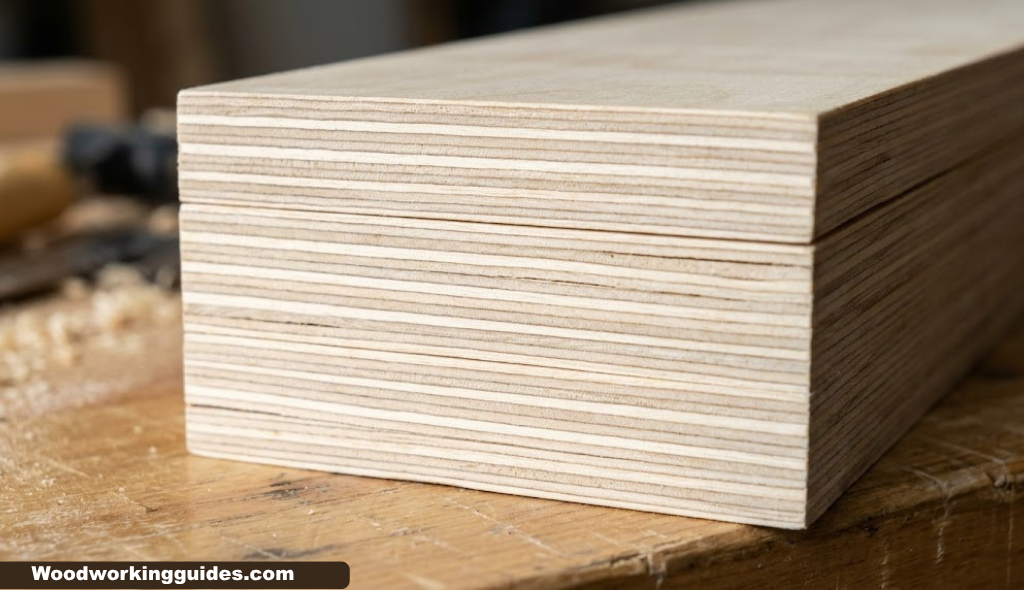
More plies of thinner veneer generally beat fewer plies of thick veneer at the same overall thickness. A 3/4-inch sheet made from 13 thin plies resists flexing and telegraphing surface irregularities far better than a 3/4-inch sheet made from just 5 thick plies. This is the core reason Baltic birch and Russian birch plywoods, which are typically laid up in very thin veneers, feel so much denser and more rigid than a comparable thickness of standard AC or CDX plywood.
Core Species and Density
Birch, beech, and maple-veneer plywoods produce a hard, tight-grained surface that resists denting from dropped tools and daily mallet work. Softwood-core plywoods (fir, pine) are lighter and cheaper but dent more easily and can fuzz up under repeated sanding and finishing. If your bench top will double as an assembly surface where dead flatness under clamping pressure really counts, prioritize core density over price.
Flatness and Moisture Resistance
A bench top that isn’t flat out of the box will never magically flatten itself once installed — it will fight you every time you try to true up a board against it. Buy from a supplier that stores sheet goods flat (not leaning against a wall for months) and inspect the sheet by sighting down its length and width before you buy. Moisture resistance matters too, especially in an unheated garage shop; a phenolic-resin adhesive (as used in exterior and marine-grade plywoods) will tolerate humidity swings far better than an interior-grade urea-formaldehyde glue line.
Plywood Types Explained
Not every plywood on the shelf is built the same way, and the differences go well beyond face veneer color. Here’s how the main categories stack up specifically for bench-top duty.
Baltic Birch Plywood
Manufactured mainly in Russia, Finland, and the Baltic states, this is the gold standard most experienced woodworkers reach for. It’s built from an odd number of thin birch veneers (often 1.5mm each), void-free, and typically comes in metric 5×5-foot sheets rather than the standard 4×8. The result is an exceptionally flat, dense, splinter-resistant panel with attractive edge-grain striping that many builders leave exposed rather than banding over.
Baltic/Russian Birch Alternatives (ApplePly, Europly)
North American manufacturers produce birch plywoods under names like ApplePly and Europly that mimic the thin-ply, void-free construction of true Baltic birch, sometimes using a mixed maple-and-birch veneer stack. These are excellent substitutes where true Baltic birch isn’t locally stocked, though pricing runs similar or slightly higher.
Cabinet-Grade Hardwood Plywood (Maple, Oak-Faced)
Standard cabinet-grade plywood with a hardwood face veneer over a softwood or MDF core. These look fantastic and machine cleanly, but the softwood or MDF core beneath the face veneer means the bench-top surface is only as dent-resistant as that thin face layer — once it’s worn through, you’re into softer, less attractive material.
MDF-Core and Combination-Core Plywood
MDF-core plywood swaps the inner veneers for a solid medium-density fiberboard core, faced with thin veneer on both sides. It machines exceptionally flat and dead smooth, which some builders love for an assembly-table surface, but it’s heavier, less impact-resistant, and swells badly if it ever gets wet. It also holds screws poorly compared with veneer-core plywood, which matters if you’re mounting a vise directly through the top.
Marine-Grade Plywood
Built to the same void-free, thin-veneer standard as Baltic birch but bonded with a fully waterproof phenolic-resin adhesive, marine plywood is the choice for an outdoor workbench, a boat shop, or an unheated, humid garage. The waterproofing comes at a real cost premium and, for a climate-controlled indoor shop, is usually more durability than you actually need.
Standard Construction Plywood (CDX / OSB)
Cheap, widely available, and generally a poor choice for a serious bench top. Internal voids, rough C/D face grading, and softwood veneers mean the surface dents, chips, and telegraphs unevenly almost immediately. It’s fine for a torsion-box core hidden beneath a better wear surface, but it should never be the top layer you actually work on.
| Plywood Type | Void-Free? | Dent Resistance | Typical Cost | Best Use |
|---|---|---|---|---|
| Baltic Birch | Yes | Excellent | $$$ | Primary bench-top surface |
| ApplePly / Europly | Yes | Excellent | $$$ | Primary bench-top surface |
| Cabinet-Grade Hardwood | Sometimes | Good (face only) | $$ | Secondary or veneered top |
| MDF-Core Plywood | Yes | Fair | $$ | Flat assembly table |
| Marine Grade | Yes | Excellent | $$$$ | Outdoor / humid shop bench |
| CDX / Construction | No | Poor | $ | Hidden torsion-box core only |
If your priority is matching the wear layer to a specific wood species for tool storage, drawers, or a matching apron, it’s worth comparing these plywood options against solid stock choices in our guide to the best wood for a woodworking bench, which covers how species selection affects everything from weight to long-term wood movement.
Best Plywood Picks Compared
With the categories established, here’s how the top real-world contenders compare when judged purely on workbench-top performance: flatness out of the box, dent resistance, screw-holding strength, and value per sheet.
1. Baltic Birch Plywood, 3/4-inch, 13-ply
The benchmark against which everything else gets measured. Thirteen thin plies at 3/4-inch overall thickness produce a panel that resists flexing under clamping pressure and takes bench-dog holes cleanly without blowing out the far face. Its main downside is availability — many U.S. lumberyards only special-order true Baltic birch, and it typically ships in 5×5 sheets rather than the 4×8 size most cut lists are planned around.
Pros
- Void-free, extremely flat and stable
- Excellent screw and dowel holding power
- Attractive exposed edge-grain look
Cons
- Higher price per sheet
- Non-standard 5×5 sheet size in many regions
- Can be harder to source locally
2. ApplePly / Europly Cabinet-Grade Birch
A domestically produced alternative built to a similar void-free, thin-ply standard, usually available in standard 4×8 sheets, which makes cut-list planning noticeably easier. Slightly more expensive at some suppliers than imported Baltic birch, but often easier to get delivered without freight surcharges.
Pros
- Standard 4×8 sheet size
- Void-free construction
- Consistent domestic supply chain
Cons
- Premium pricing at most suppliers
- Slightly less dense than true Baltic birch in some batches
3. Marine-Grade Fir or Meranti Plywood
The right call for a bench that lives in a garage, shed, or boat shop where humidity swings are unavoidable. The waterproof phenolic glue line keeps the panel from delaminating even with repeated wet-dry cycles.
Pros
- Fully waterproof adhesive
- Void-free, consistent core
- Handles humid or unheated shops well
Cons
- Most expensive option on this list
- Overkill for a climate-controlled indoor shop
4. MDF-Core Hardwood Plywood
Best reserved for an assembly-table top rather than a primary work surface, since its dead-flat, ultra-smooth face is fantastic for glue-ups but the MDF core dents and swells more readily than a veneer core.
Pros
- Exceptionally flat and smooth
- Consistent thickness, minimal sanding needed
Cons
- Poor screw-holding compared to veneer core
- Swells badly if it gets wet
- Heavier per sheet
5. Standard Cabinet-Grade Plywood (Softwood Core)
An acceptable budget compromise for a first bench or a secondary work surface, provided you inspect sheets individually for voids and choose the highest face grade available.
Pros
- Widely available in standard sizes
- Lowest cost per sheet
Cons
- Risk of hidden internal voids
- Softer face veneer dents more easily

Building in a garage or unheated shop? Marine-grade plywood’s waterproof glue line is worth the upgrade for benches exposed to humidity swings.
Check Price on AmazonThickness Guide: How Thick Should Your Bench Top Be?
Thickness affects three things: resistance to flexing under clamping and mallet blows, the depth available for bench-dog holes and vise hardware, and total weight, which contributes to the bench’s overall stability. There’s no single “correct” thickness — it depends on bench style and how the top is supported underneath.
| Bench Style | Recommended Thickness | Notes |
|---|---|---|
| Lightweight / portable bench | 3/4″ single sheet | Best paired with a torsion-box frame underneath for rigidity |
| Standard hobbyist bench | 1.5″ (two laminated 3/4″ sheets) | Most common configuration; good balance of weight and rigidity |
| Heavy assembly / clamping bench | 2.25″–3″ (3–4 laminated sheets) | Maximum rigidity for large glue-ups and mortise work |
| Outdoor / shed bench | 1.5″ marine-grade, laminated | Thicker cross-section resists moisture-driven cupping |
Laminating two or three sheets of 3/4-inch plywood face-to-face, with the grain of alternating layers running perpendicular where possible, produces a top that’s dramatically more resistant to flexing than a single thick sheet, while also letting you hide a cheaper structural layer beneath a premium wear-layer face sheet. This lamination approach is the single most cost-effective way to get Baltic-birch-level performance on the visible face without paying premium prices for the full thickness.
If you’re still finalizing your overall bench dimensions and joinery, our downloadable woodworking workbench plans PDF includes cut lists calibrated to these exact thickness recommendations, which saves you from re-cutting stretchers and aprons after the fact.
Baltic Birch vs Regular Plywood: Side-by-Side
Because this comparison comes up in almost every workbench build thread, it’s worth putting the two head-to-head on the metrics that actually matter for a work surface.
| Property | Baltic Birch | Regular (Softwood Core) Plywood |
|---|---|---|
| Ply count at 3/4″ | 11–13 thin plies | 5–7 thicker plies |
| Internal voids | None | Common, hidden |
| Edge appearance | Clean, stripe-patterned | Rougher, uneven layer lines |
| Screw holding | Excellent | Fair to good |
| Dent resistance | Very high | Low to moderate |
| Weight | Heavier, denser | Lighter |
| Price per sheet | Higher | Lower |
The takeaway isn’t that regular plywood is unusable — plenty of functional benches are built from it — but that Baltic birch earns its price premium specifically in the areas that matter most for a work surface: resistance to denting, reliable screw and bolt holding for vise hardware, and long-term flatness.
Single Sheet vs Torsion Box Construction
There are two fundamentally different approaches to building a plywood bench top, and the right choice depends on how much rigidity and mass you actually need.
Single or Laminated Solid Slab
Two or three sheets of plywood glued face-to-face into one solid slab. This is the simplest approach and produces a heavy, dense top that resists flexing purely through mass and thickness. It’s the traditional choice for hand-tool-focused benches where the top itself needs to resist racking under hand-plane pressure.
Torsion Box
A torsion box uses a lightweight internal grid of plywood or MDF ribs sandwiched between two thin plywood skins, similar in principle to a hollow-core door but built to much tighter tolerances. The result can be just as rigid as a solid slab at a fraction of the weight, which matters if the bench needs to be moved. This is also the preferred approach for a portable woodworking workbench, where every extra pound works against you.
| Factor | Solid Laminated Slab | Torsion Box |
|---|---|---|
| Weight | Heavy | Light to moderate |
| Rigidity per pound | Lower | Higher |
| Build complexity | Low | Moderate |
| Dog-hole depth available | Full thickness | Limited to skin thickness at hole locations |
| Best for | Stationary, hand-tool benches | Portable or space-limited setups |

Laminating multiple sheets? A waterproof, high-strength wood glue is essential for a bench top that won’t delaminate under years of clamping pressure.
Check Price on AmazonFinishing and Surface Protection
Even the best plywood benefits from a finish that protects against glue squeeze-out, moisture, and daily wear without making the surface so slick that clamps and jigs slide around.
Penetrating Oil Finishes
Boiled linseed oil or a hardwax oil soaks into the surface veneer, offers modest moisture resistance, and is simple to re-apply after years of sanding and re-flattening. It won’t build a hard film, which means glue squeeze-out pops off cleanly rather than bonding to a lacquer layer.
Film Finishes (Polyurethane, Varnish)
A wipe-on or brushed polyurethane creates a harder, more water-resistant film that resists staining better than oil alone, at the cost of eventually needing to be scraped and refinished once it wears through in high-traffic zones.
Sacrificial Hardboard or Replaceable Skins
Many builders skip finishing the main top altogether and instead screw down a thin, replaceable sheet of tempered hardboard or MDF as a sacrificial work surface. When it gets chewed up by glue and cuts, it’s unscrewed and swapped for a fresh sheet in minutes, protecting the good plywood underneath indefinitely.
Sizing and Cutting Your Plywood Top
Getting clean, straight, splinter-free cuts on a plywood panel this size requires a bit more care than trimming solid stock, since tear-out on the show face is much harder to sand away without going through the thin face veneer.
Breaking Down Full Sheets
Use a track saw or a straightedge guide with a circular saw for the initial breakdown of a full 4×8 or 5×5 sheet — wrestling an entire sheet across a table saw alone is both inaccurate and genuinely dangerous. Score the cut line first with a utility knife on the face veneer to prevent tear-out before the saw blade reaches it.
Squaring and Final Dimensioning
Once broken down to rough size, square up the panel on a table saw with a sled or a quality rip fence, taking a light final pass on all four edges. For laminated multi-layer tops, cut each layer slightly oversized and flush-trim the stack together after glue-up with a flush-trim router bit for perfectly matched edges.
Blade Selection
A high tooth-count plywood or fine-crosscut blade (60+ teeth) dramatically reduces face-veneer tear-out compared with a standard combination blade. This matters most on the visible top face; the hidden underside can tolerate a rougher cut.
Attaching the Top to Your Base
How you fasten the top to the base affects both long-term stability and your ability to eventually flip, replace, or re-flatten the top without rebuilding the entire bench.
Screwed Through Elongated Holes
Rather than fixed pilot holes, drill slightly elongated (slotted) holes through the aprons or cleats that attach to the underside of the top. This allows the plywood to expand and contract slightly across seasons without splitting the base joinery, even though plywood moves far less than solid lumber.
Figure-8 Desktop Fasteners
A common cabinetmaker’s trick borrowed from tabletop construction: metal figure-8 fasteners let the top float slightly relative to the base while still being pulled down firmly, and they’re trivially easy to remove if you ever need to swap the top for a fresh one.
Direct Glue and Screw (Permanent Mount)
For maximum rigidity, some builders glue and screw the top directly to the base with no allowance for movement at all. This works fine with plywood specifically because of its dimensional stability, but it does mean a full disassembly is required if the top is ever damaged beyond repair.

Mounting a vise on your new top? A quality bench vise is only as good as the plywood surface it’s bolted through — reinforce before you drill.
Check Price on AmazonMaintenance and Longevity
A well-chosen plywood top, properly finished and maintained, can genuinely outlast the base it sits on. A few habits keep it flat and functional for the long haul.
Periodic Flattening
Even a quality plywood top can develop minor low spots from years of localized wear. A light pass with a hand plane or a wide-belt sander every few years restores flatness without removing enough material to compromise the thin face veneer — this is exactly why a slightly thicker starting point pays off over a bench’s lifetime.
Glue Squeeze-Out Removal
Scrape dried glue off promptly with a sharp card scraper rather than sanding it, which just embeds glue dust into the surrounding pores and creates blotchy spots under a fresh finish coat.
Moisture Monitoring
In an unheated garage or shed, watch for any sign of edge swelling or delamination at the sheet’s perimeter, which is usually the first place moisture intrusion shows up. Sealing exposed plywood edges with a bead of finish or edge banding dramatically slows this process.
Common Mistakes to Avoid
- Buying the cheapest sheet without inspecting for voids. A single hidden void under a future dog-hole location can ruin an otherwise perfect top.
- Skipping edge banding or sealing on exposed plywood edges. Raw plywood edges are the fastest path to moisture-driven delamination.
- Under-thicknessing a bench meant for heavy clamping work. A thin single sheet flexes noticeably under serious glue-up pressure.
- Ignoring grain direction when laminating multiple layers. Alternating grain direction between laminated sheets adds real rigidity; stacking them all the same way wastes that benefit.
- Finishing with a high-build gloss film. It looks impressive briefly and then becomes frustratingly slick for clamping and jig work.
- Forgetting to reinforce vise mounting points. This is consistently the first place an otherwise solid top begins to fail.
Frequently Asked Questions
What is the best plywood for a workbench top?
Void-free Baltic birch, or a domestic equivalent like ApplePly, is generally considered the best plywood for a workbench top because of its thin, tightly stacked veneer layers, absence of internal voids, and excellent dent and screw-holding performance.
How thick should plywood be for a workbench top?
Most hobbyist benches perform well with 1.5 inches of thickness, achieved by laminating two 3/4-inch sheets. Heavy assembly benches benefit from 2.25 to 3 inches, while lightweight or torsion-box-supported tops can work with a single 3/4-inch sheet.
Is Baltic birch plywood worth the extra cost for a bench top?
For most serious woodworkers, yes. The void-free construction and dense, thin-ply layup translate directly into better dent resistance and more reliable screw and vise-mounting hardware holding, which matters far more on a heavily used bench top than on cabinetry.
Can I use MDF instead of plywood for a workbench top?
MDF-core plywood or solid MDF can work well as a flat assembly-table surface, but it dents more easily than veneer-core plywood and swells significantly if exposed to moisture, so it’s better suited as a secondary surface than the primary heavy-use top.
Should I use one thick sheet or laminate multiple thinner sheets?
Laminating two or three sheets of thinner plywood, with grain directions alternated where possible, generally produces a more rigid, warp-resistant top than a single thick sheet, and lets you use a premium face sheet over a cheaper structural core.
How do I stop a plywood bench top from warping?
Choose void-free, quality plywood to start, seal all exposed edges to slow moisture absorption, support the underside adequately with cleats or a torsion-box frame, and store or finish both faces evenly so one side doesn’t absorb more moisture than the other.
What finish should I put on a plywood workbench top?
A penetrating oil finish, such as boiled linseed oil or a hardwax oil, is popular because it protects the surface without building a slick film, and it’s easy to refresh after periodic sanding or flattening.
Is marine-grade plywood necessary for an indoor workbench?
Not usually. Marine-grade plywood’s waterproof adhesive is mainly valuable for outdoor use or unheated, humid garages and sheds; for a climate-controlled indoor shop, standard void-free hardwood plywood is generally sufficient and more cost-effective.
How do I attach a plywood top to a workbench base?
Common methods include screwing through slightly elongated holes in cleats or aprons, using metal figure-8 desktop fasteners for a semi-floating mount, or gluing and screwing directly for maximum rigidity when future removal isn’t a priority.
Can I repair dents or damage in a plywood bench top?
Minor dents can often be steamed out with a damp cloth and a clothes iron, which swells the compressed wood fibers back toward their original shape. Deeper gouges or worn dog-holes are typically repaired with a glued-in patch or by adding a fresh sacrificial layer over the damaged area.
What size plywood sheet do I need for a standard bench top?
Most home workbenches run between 5 and 7 feet long and 24 to 30 inches deep, which fits comfortably within a single standard 4×8 sheet with minimal waste, or a 5×5 Baltic birch sheet with a small extension piece for longer benches.
Does the plywood species affect how well glue and finish adhere?
Yes, to a degree. Denser hardwood veneers like birch and maple generally take glue and film finishes evenly, while some oily or naturally resinous species can require a light scuff-sand or a compatible primer coat to ensure good adhesion.
Conclusion: Choosing the Right Plywood for Your Bench
The best plywood for a workbench top is the one that matches how hard you actually plan to use it. For most serious hobbyists and professionals, void-free Baltic birch or a domestic equivalent like ApplePly delivers the best long-term combination of flatness, dent resistance, and reliable hardware holding. Budget-conscious builders can get remarkably close to that performance by reserving the premium sheet for the visible top layer and laminating a cheaper structural core beneath it, while anyone building for a garage or outdoor shop should strongly consider a marine-grade sheet for its waterproof glue line.
Whatever you choose, remember that thickness, careful edge sealing, and a sensible finish matter just as much as the plywood grade itself. Get those fundamentals right and your bench top will likely outlast the base it’s sitting on. For the full picture on choosing a complete bench system — not just the top — revisit our guide to the best woodworking workbench, and once your bench is built, protect your hands and clothing with a solid woodworking apron before you put that new top to work.
Shop Bench-Top Plywood on Amazon