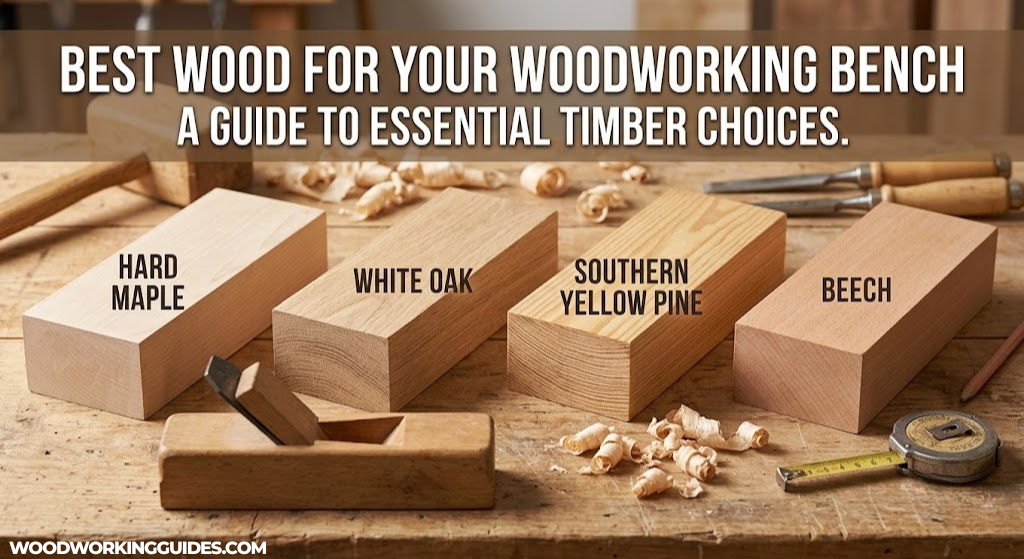
Best Wood for Woodworking Bench: The Ultimate Material Guide
1. Introduction: The Foundation of Your Craft
When you commit to building the best woodworking workbench possible, you are not just building a table; you are constructing the most important tool in your shop. A true workbench is an active participant in your craft. It holds your stock securely, resists the heavy lateral forces of hand planing, absorbs the shock of mortising with a mallet, and remains dead flat for precision joinery.
Because the bench performs so many physical tasks, the material you choose dictates its success. Select a wood that is too soft, and it will quickly become chewed up and uneven. Select a wood that is excessively prone to seasonal movement, and your meticulously flattened top will warp out of true. In this comprehensive guide, we are analyzing the best wood for a woodworking bench across all budgets, availability levels, and traditional standards.
2. Key Characteristics of the Ideal Workbench Wood
Before you run to the lumber yard, it is vital to understand the physics of a workbench. You cannot choose a wood based purely on aesthetics. You need a material that delivers on three distinct mechanical properties:
Density and Mass
A lightweight bench is a frustrating bench. When you push a No. 7 jointer plane across a board, you apply significant forward and lateral force. If your bench lacks mass, it will “walk” across the floor. Wood density is usually measured in pounds per cubic foot (lbs/ft³). The higher the density, the heavier your bench top will be. You want a completed bench to weigh well over 200 pounds—ideally upwards of 300 pounds.
Janka Hardness
The Janka hardness test measures the force required to embed a 0.444-inch steel ball halfway into the wood. For a workbench, you need a surface that resists denting when a heavy tool is dropped, but you don’t necessarily want a surface harder than your workpieces, as the bench could dent the furniture you are trying to build.
Stiffness (Modulus of Elasticity)
A workbench top must not deflect or sag under heavy loads. Stiffness ensures that when you apply downward pressure—whether leaning into a router or hammering a chisel—the bench top transfers that energy efficiently without bouncing.
| Wood Species | Janka Hardness (lbf) | Density (lbs/ft³) | Stiffness (M of E) |
|---|---|---|---|
| Hard Maple | 1,450 | 44 | 1,830,000 lbf/in² |
| European Beech | 1,300 | 44 | 1,630,000 lbf/in² |
| White Oak | 1,360 | 47 | 1,780,000 lbf/in² |
| Douglas Fir | 660 | 32 | 1,700,000 lbf/in² |
| Southern Yellow Pine | 690 | 36 | 1,780,000 lbf/in² |
3. Hard Maple: The Undisputed King of Workbenches
If budget and availability are non-issues, Hard Maple (Sugar Maple) is universally heralded as the premier wood for traditional woodworking benches. Walk into any professional cabinet shop or historic preservation studio, and you will likely find a massive Roubo or Nicholson style bench crafted from hard maple.
Why is it the king? Hard maple strikes the absolute perfect balance. With a Janka hardness of 1,450 lbf, it is exceptionally tough and highly resistant to denting and abrasion. More importantly, it features a very tight, closed grain. Unlike open-grained woods that trap dirt, glue, and wood shavings, maple remains smooth. When glue drips onto a maple bench, it can usually be popped right off with a scraper once dry without tearing the grain.
Pros
- Incredible density providing immense bench weight.
- Closed grain prevents glue and dirt buildup.
- Turns beautifully pale and reflects light well.
- Holdfasts grip incredibly well in thick maple.
Cons
- Can be very expensive in thick 8/4 or 12/4 slabs.
- Difficult to work with hand tools (flattening the top is a workout).
- Can burn easily on the table saw or router.
Before buying your maple, it’s a good idea to lay out your cut list perfectly. Referencing a woodworking workbench plans PDF can help you calculate exactly how many board feet you need, preventing expensive waste.

Build Your Dream Bench with Premium Maple
Ready to source your materials? High-quality hard maple offers the best longevity and work surface for serious woodworkers. Stock up on S4S lumber for a perfect lamination.
Check Price on Amazon4. Beech: The European Classic Alternative
If Hard Maple is the American standard, European Beech is its transatlantic counterpart. For centuries, European bench makers—including legendary brands like Sjobergs and Hofmann & Hammer—have relied on steamed beech for their flagship models.
Beech boasts a density and hardness remarkably similar to hard maple. It has a Janka rating of around 1,300 lbf, making it plenty stiff and heavy. Aesthetically, beech has a slightly warmer, pinkish-amber hue compared to the stark white of maple. Its grain is also closed, offering the same glue-resistant benefits.
The primary reason you might choose Beech over Maple in North America is availability and price variance, though imported European Beech can sometimes cost more. One structural quirk of beech is that it has a higher rate of volumetric shrinkage than maple, meaning it moves a bit more with humidity changes. Proper joinery and allowing the wood to acclimate to your shop environment before milling are essential.
5. Ash: Flexibility and Shock Resistance
White Ash is frequently overlooked as a workbench material, which is a shame because it possesses some of the best mechanical properties for heavy shop furniture. Ash has a Janka hardness of 1,320 lbf and excellent shock resistance. This is exactly why ash is traditionally used for baseball bats and tool handles—it absorbs impact without shattering.
When you are chopping heavy mortises on your workbench, the top needs to absorb the blow of the mallet rather than transferring it as a reverberating bounce. Ash does this beautifully.
The main drawback to ash is its open grain. Similar to oak, the deep pores in ash can collect sawdust, finishing oils, and dried glue. Over years of heavy use, an ash bench can take on a grimy appearance if not scraped clean regularly. However, for sheer mechanical performance and a lower price point than maple, Ash is a top-tier choice.
6. White Oak: Heavy-Duty and Timeless
White oak is a powerhouse of a wood. It is heavy, exceptionally strong, and highly resistant to rot and wear. At 1,360 lbf on the Janka scale and 47 lbs/ft³ in density, a white oak bench will be an absolute tank. It will never rack, shift, or vibrate if built correctly.
When comparing White Oak to Red Oak, White Oak is vastly superior for workbenches. Red oak has an extremely open, porous grain (so porous you can blow air through a short end-grain piece). White oak’s pores are plugged by tyloses, making it a “closed” structure despite having a visibly coarse texture. This makes white oak more stable and less prone to trapping moisture.
Pros
- Incredibly heavy and stable base.
- Classic, beautiful aesthetic that ages well.
- Exceptional durability against dropped tools.
Cons
- Can splinter easily on the edges if not chamfered.
- Tannic acid in oak can react with iron tools, leaving black stains (especially when wet).
- Requires sharp, high-quality cutting tools to mill.
Protect your clothing from the sharp chips of oak by investing in the best woodworking apron before milling these heavy slabs.

Heavy Duty White Oak Stock
Build a generational workbench that will never move on you. White oak provides the ultimate mass and strength for traditional mortise and tenon bench bases.
Check Price on Amazon7. Douglas Fir: The Best Softwood Choice
Who says a workbench has to be hardwood? Throughout history, countless master craftsmen have built their benches from standard construction softwoods. Among softwoods, Douglas Fir reigns supreme.
Douglas fir has a phenomenal stiffness-to-weight ratio. While its Janka hardness is only 660 lbf, its Modulus of Elasticity (stiffness) is a massive 1,700,000 lbf/in²—rivaling many hardwoods. This means a Douglas Fir top that is 3.5 to 4 inches thick will not deflect under pressure.
The beauty of Douglas Fir is cost and availability. You can go to a local home center, sort through the 2×10 or 2×12 framing lumber (which tends to have clearer grain than 2x4s), rip them down, and laminate them into a massive, incredibly strong top for a fraction of the cost of maple. Yes, the surface will dent faster than hardwood, but many woodworkers prefer this! A dented bench top means the dropped project piece didn’t dent instead.
8. Southern Yellow Pine: Budget-Friendly Mass and Strength
Similar to Douglas Fir, Southern Yellow Pine (SYP) is a darling of the modern hand-tool woodworking movement. Popularized heavily by modern woodworking authors and instructors, SYP is incredibly cheap, widely available in the Eastern and Southern United States, and surprisingly heavy.
With a density of 36 lbs/ft³ and a Janka rating around 690 lbf, SYP is one of the hardest and heaviest softwoods available. A bench built entirely out of cheap SYP 2x12s (ripped and laminated to avoid the pith) will easily top 250 pounds.
SYP can be quite resinous and pitchy, meaning it can gum up your saw blades and hand plane soles. Wiping your tools with mineral spirits and applying paste wax regularly is a must when working with this wood. Despite the sap, SYP offers an unbeatable cost-to-performance ratio.
9. Plywood vs. Solid Wood: Analyzing the Options
If laminating 25 boards of solid wood together sounds like a nightmare, you aren’t alone. Many woodworkers opt for sheet goods. But can plywood serve as a legitimate workbench top?
The answer is yes, with caveats. High-quality Baltic Birch plywood is incredibly dimensionally stable. It will never cup, twist, or bow with humidity changes like solid wood might. By laminating three layers of 3/4-inch plywood, you achieve a flat, rigid 2.25-inch top very quickly.
However, plywood lacks the holding power required for traditional friction holdfasts. The layered glue and veneer structure tends to crumble inside the dog holes under the wedging action of a heavy iron holdfast. Plywood is better suited for a modern Paulk-style bench or an assembly table rather than a traditional hand-tool bench.
If you choose this route, research the best plywood for workbench top construction to ensure you don’t buy void-riddled exterior sheathing.

Essential Workbench Hardware
No matter what wood you choose, you need high-quality hardware. Equip your newly built bench top with a heavy-duty cast iron front vise for maximum gripping power.
Check Price on Amazon10. MDF (Medium Density Fiberboard): Flatness on a Budget
MDF is heavy, perfectly uniform, dead flat, and cheap. For power-tool woodworkers whose primary need is a flat assembly and track-saw cutting surface, an MDF top is brilliant. Two layers of 3/4-inch MDF glued together provide massive weight and a perfectly planar surface.
The fatal flaw of MDF is its fragility. The edges crush easily, it swells irreparably if exposed to water or wet glue, and it cannot hold a traditional holdfast. If you build an MDF top, you must wrap the perimeter in a hardwood edge banding (like Maple or Oak) to protect the fragile edges from impact.
Many woodworkers use a solid core door or plywood base, topped with a 1/4-inch piece of tempered hardboard (Masonite) or MDF as a sacrificial surface. When it gets ruined, you simply unscrew it and replace it for a few dollars.
11. Exotic Woods: Are They Worth the Investment?
Occasionally, you will see a jaw-dropping workbench made of Bubinga, Purpleheart, or Mahogany. These woods are phenomenally dense and incredibly hard.
However, from a practical standpoint, exotic woods are generally a poor choice for a daily-driver workbench. A bench made of Purpleheart is so hard that it can dull your tools and shatter edge tools if dropped. The dark colors of exotic woods also absorb light. A workbench needs to reflect light so you can clearly see your layout lines and joinery gaps. Light woods like Maple and Pine illuminate the workspace.
Furthermore, the cost is prohibitive. Spending thousands of dollars on bench lumber can make you overly protective of the surface, preventing you from actually working hard on it. A bench is a tool, not fine furniture.
12. How to Mix and Match Woods for Your Bench
You don’t have to use just one species of wood. In fact, hybrid designs are incredibly smart and cost-effective. Here are some proven combinations:
- Pine Base with a Maple Top: Spend your money where the action happens. Build massive, heavy legs and stretchers out of cheap Douglas Fir, and invest in a hard Maple top for durability.
- MDF Core with Hardwood Edging: Use laminated MDF for a heavy, flat core, and wrap the outside edges (where vices and dog holes go) in 3-inch thick Ash or Oak.
- Softwood Top with a Hardwood Tool Well: A traditional design element that saves weight and money in the non-critical areas.
If you are building a small, space-saving unit, these hybrid methods are critical. The best portable woodworking workbench often uses a combination of light aluminum or pine legs with a dense bamboo or maple top to balance portability and strength.

Protect Your Investment
Once your top is flattened, you need to seal it. Boiled Linseed Oil or a simple wiping varnish protects the wood without creating a slick, slippery film that causes workpieces to slide.
Check Price on Amazon13. Quartersawn vs. Flatsawn: Grain Orientation for a Stable Top
Most woodworkers focus exclusively on species when picking bench material, but the way a board was sawn from the log matters just as much as what tree it came from. Lumber is milled in three basic orientations: flatsawn (plain sawn), quartersawn, and riftsawn. Each behaves differently when it comes to seasonal movement, and a workbench top spends its entire life fighting seasonal movement.
Flatsawn boards are cut tangentially to the growth rings, producing the classic cathedral grain pattern you see in most home center lumber. It is the cheapest and most widely available cut, but it is also the most prone to cupping. A wide flatsawn board glued into a benchtop will often develop a slight dish shape across its width as humidity swings through the seasons, forcing you to re-flatten more frequently.
Quartersawn lumber is cut radially, roughly perpendicular to the growth rings, so the growth rings run vertically through the thickness of the board rather than horizontally. This orientation dramatically reduces cupping and makes the board far more dimensionally stable across its width. The tradeoff is cost: quartersawn lumber requires more waste and labor to produce, so it typically carries a fifteen to thirty percent price premium over flatsawn stock of the same species.
Riftsawn falls between the two, with growth rings running at roughly a thirty to sixty degree angle. It offers a good compromise of stability and yield, and many bench builders specifically request rift-sawn White Oak or Ash for leg posts, where twisting under racking loads is the primary concern.
For a laminated strip-style benchtop, this conversation becomes less critical because narrow strips (two to three inches wide) are far less prone to cupping regardless of orientation, and alternating the growth-ring direction of each strip during glue-up further cancels out any residual movement. However, if you are building a slab-style top from a small number of very wide boards, seeking out quartersawn or riftsawn stock is one of the single best decisions you can make for long-term flatness.
| Sawing Method | Typical Movement | Relative Cost | Best Use on a Bench |
|---|---|---|---|
| Flatsawn | High cupping tendency | Lowest | Narrow laminated strips only |
| Riftsawn | Moderate movement | Moderate | Legs, stretchers, aprons |
| Quartersawn | Very stable | Highest | Wide slab tops |
14. Kiln-Dried vs. Air-Dried Lumber: Why Moisture Content Matters
No matter which species you settle on, the moisture content of the lumber at the time of construction will make or break your project. Freshly milled “green” wood can carry a moisture content well above thirty percent. Furniture-grade lumber destined for indoor use needs to be brought down to somewhere between six and nine percent moisture content before it is safe to mill, glue, and assemble.
Kiln-dried lumber is dried in a controlled, heated chamber over a period of days to weeks, bringing it down to a stable six to eight percent moisture content quickly and consistently. This is the standard offering at most hardwood dealers and big-box home centers, and it is generally the safer choice for a first-time bench builder because the risk of hidden internal stress or excess moisture is low.
Air-dried lumber is stacked and stickered outdoors or in a barn and left to dry naturally over a period of one year per inch of thickness. Many traditionalists prefer air-dried stock for benchtops because the slower drying process is thought to preserve more of the wood’s natural resilience and produces less case-hardening than aggressive kiln schedules. The tradeoff is unpredictability: air-dried lumber purchased from a small sawyer may still be sitting at twelve to fifteen percent moisture content, which is too wet to build with immediately.
Regardless of which drying method your lumber went through, always check moisture content with a pin or pinless moisture meter before you start ripping and jointing. A cheap moisture meter is one of the best investments a bench builder can make, since it removes the guesswork entirely. Just as importantly, let your lumber acclimate inside your actual shop for at least one to two weeks, stickered with airflow on all faces, so it can equalize to your specific environment before you commit to final dimensions.
Skipping this step is the number one cause of a workbench top that looks perfectly flat on glue-up day and then twists or opens glue joints within a few months. Patience during the drying and acclimation phase costs nothing but time, while skipping it can cost you an entire slab of expensive maple or oak.
15. Walnut, Cherry, and Hickory: Underrated Bench Wood Alternatives
Beyond the five headline species covered earlier, several other domestic hardwoods deserve consideration, especially if you already have access to them through a local sawyer or a stash of shop scraps.
Black Walnut
Walnut is prized in furniture making for its rich chocolate color, but as a bench wood it is a mixed bag. At roughly 1,010 lbf on the Janka scale, it is noticeably softer than maple or oak, meaning the surface will dent more readily under heavy use. Walnut is also comparatively expensive per board foot. Where walnut does shine is dimensional stability; it moves less with seasonal humidity than almost any other domestic hardwood, making it an excellent choice for a bench base or leg vise chop where movement could bind moving parts.
Cherry
Cherry sits even softer than walnut on the hardness scale, at around 950 lbf, and darkens attractively with age and UV exposure. Its softness makes it a poor choice for a primary work surface that will see constant tool abuse, but it laminates beautifully and machines cleanly, so some woodworkers use it for a secondary assembly table or a tool cabinet integrated into the bench base.
Hickory
Hickory is the toughest domestic hardwood commonly available, with a Janka rating north of 1,800 lbf in some varieties—harder than maple, oak, or ash. It absorbs shock exceptionally well, which is why it is the standard material for axe and hammer handles. The downside is that hickory is notoriously difficult to work with hand tools; it dulls edges quickly and its interlocked grain can tear out unpredictably during planing. For a power-tool-only shop, however, a hickory benchtop is nearly indestructible.
| Wood Species | Janka Hardness (lbf) | Best Bench Application |
|---|---|---|
| Black Walnut | 1,010 | Leg vise chops, stable base components |
| Cherry | 950 | Secondary assembly surfaces, cabinets |
| Hickory | 1,820 | Power-tool workbench tops, tool handles |
16. Bamboo Workbench Tops: A Modern Engineered Option
Bamboo is technically a grass rather than a hardwood, but manufactured bamboo panels have become a legitimate contender for workbench and workshop table tops over the past decade. Strand-woven bamboo, in particular, is compressed and heat-treated under enormous pressure, producing a panel with a Janka hardness that can rival or exceed hard maple, often tested above 3,000 lbf for the densest strand-woven varieties.
The primary appeal of bamboo is sustainability. Bamboo reaches harvestable maturity in three to five years, compared to forty to sixty years for hard maple, making it a genuinely renewable resource. Bamboo panels also arrive pre-glued and dimensionally stable, eliminating the need to laminate dozens of individual boards yourself.
There are real tradeoffs, though. Bamboo’s extreme hardness, especially in strand-woven form, can be brutal on edge tools, dulling chisels and plane irons faster than most traditional hardwoods. The adhesives used to bind bamboo strands can also gum up carbide blades over time. Additionally, drilling dog holes into bamboo requires extremely sharp, high-quality drill bits, as the dense fibers tend to chip and tear out around the hole’s edge with dull tooling.
Bamboo tops are best suited to woodworkers who primarily use power tools and want a modern, light-colored, eco-friendly surface without the wait times and waste associated with solid lumber lamination. For hand-tool purists chasing the classic Roubo aesthetic, traditional hardwoods remain the more forgiving choice.
17. Torsion Box Construction: A Lightweight Structural Alternative
Not every workbench needs to rely on sheer mass for rigidity. A torsion box is a hollow, grid-reinforced panel—essentially a very strong, lightweight version of a solid-core door—that achieves exceptional stiffness through geometry rather than density. It consists of two thin skins (often 1/4-inch plywood or MDF) glued to a grid of internal ribs, similar in principle to an airplane wing or a interior door core.
For a dedicated assembly table, outfeed table, or a secondary bench meant to complement a heavier primary bench, a torsion box offers an outstanding strength-to-weight ratio. A well-built torsion box top will resist twisting and sagging far better than a solid slab of similar thickness, and because so much of its volume is empty air, it is dramatically lighter and easier to move or mount on a mobile base.
The obvious drawback is that a torsion box cannot support traditional holdfasts or heavy chopping work, since there is no solid mass beneath the surface skin to grip into. Builders who want the benefits of a torsion box while retaining some hand-tool functionality often add a solid hardwood strip along the front edge, wide enough to accept a vise and a row of dog holes, while the rest of the top remains hollow torsion-box construction. This hybrid approach captures much of the weight savings while preserving the practical holding power woodworkers rely on.
18. Sourcing Lumber: Where to Buy and How to Calculate Board Feet
Once you’ve settled on a species, the next challenge is sourcing enough clean, straight lumber at a reasonable price. Big-box home centers are convenient for softwoods like Douglas Fir and Southern Yellow Pine, but their hardwood selection is typically limited, pre-surfaced, and priced at a significant markup compared to a dedicated hardwood dealer.
A local hardwood supplier or sawmill will almost always offer better selection and pricing on rough-sawn maple, oak, ash, or walnut, and many will surface boards to your specified thickness for a small per-board-foot fee. If you don’t have a hardwood dealer nearby, online retailers specializing in domestic lumber can ship surfaced stock directly, though freight costs on heavy hardwood can add up quickly on large orders.
Regardless of where you buy, hardwood is priced and sold by the board foot rather than by the linear foot, which trips up many first-time buyers. One board foot equals a piece of wood measuring twelve inches long by twelve inches wide by one inch thick. The formula for calculating board feet is straightforward:
Board Feet = (Thickness in inches × Width in inches × Length in inches) ÷ 144
For example, a rough board that is 8/4 (two inches thick), 8 inches wide, and 96 inches long contains (2 × 8 × 96) ÷ 144, or roughly 10.7 board feet. When estimating material for a full workbench top, always add ten to fifteen percent extra to your calculated board footage to account for defects, knots, and the milling losses that occur when you joint and plane rough lumber down to final thickness.
19. Cost Breakdown: Budgeting Your Workbench Build by Wood Species
Price is often the deciding factor for many home woodworkers, and the spread between the cheapest and most expensive viable bench woods is enormous. While exact pricing fluctuates by region and market conditions, the relative cost relationships between species tend to hold steady.
| Wood Species | Relative Cost per Board Foot | Typical Top-Only Budget Range |
|---|---|---|
| Southern Yellow Pine / Douglas Fir | $ | Lowest overall |
| European Beech | $$ | Moderate |
| White Oak / Ash | $$ | Moderate to high |
| Hard Maple | $$$ | High |
| Walnut / Exotics | $$$$ | Highest |
A useful budgeting strategy is to split your spending intentionally rather than uniformly. Since the base and legs of a bench see far less direct wear than the top, it rarely makes sense to spend premium hardwood dollars there. Concentrate your budget on the top surface, where mass, hardness, and stability actually matter for daily work, and save money on the understructure with a cheaper softwood or construction-grade lumber. This single decision can cut total material cost by thirty percent or more without compromising the bench’s performance where it counts.
Don’t forget to budget for hardware as well. Vises, holdfasts, bench dogs, and finish are recurring costs regardless of which wood you choose, and a quality front vise alone can rival the cost of an entire softwood top.
20. Tool Wells: Weighing the Pros and Cons
A tool well is a recessed channel, typically running along the back of a traditional workbench, designed to keep hand planes, chisels, and squares out of the way while you work on the main surface. Tool wells were a defining feature of classic factory-made benches for much of the twentieth century, but they have fallen out of favor with many modern hand-tool woodworkers.
The case for a tool well is straightforward: it keeps your primary clamping and planing surface completely clear of loose tools that could otherwise get knocked around or damaged, and it gives you a dedicated home for items you need within arm’s reach.
The case against a tool well is equally strong. Every square inch given over to a recessed well is square inch you cannot clamp large panels across, and the well itself becomes a magnet for sawdust and shavings that must be cleaned out regularly. Many contemporary bench designs, including most Roubo-style benches, eliminate the tool well entirely in favor of a single flat, unbroken slab, relying instead on a wall-mounted tool rack or a rolling tool cart positioned beside the bench.
If you do want the convenience of a tool well, you don’t need to build it from the same premium hardwood as your primary work surface. A shallow well built from inexpensive pine or plywood, inset between two strips of your primary hardwood, gives you the functional benefit without spending premium lumber dollars on a surface you won’t be clamping or planing against directly.
21. Dog Holes, Vises, and Wood Compatibility
Bench dogs and holdfasts are only as effective as the wood surrounding their holes. A round bench dog hole, typically 3/4-inch in diameter, relies on friction against the surrounding wood fibers to stay put, while a holdfast relies on the wood’s ability to grip and flex slightly under a wedging action when tapped with a mallet.
Dense, closed-grain hardwoods like Hard Maple, Beech, and White Oak are ideal for dog holes because the wood fibers compress slightly under load and spring back, maintaining consistent friction over thousands of insertions. Softer woods like pine or basswood will gradually wallow out, and the holes become sloppy and lose their grip far sooner. If you are building a softwood bench but still want reliable holdfast performance, consider inlaying a strip of hardwood at least three inches wide along the front edge of the top specifically to house your dog holes and vise chop, even if the rest of the surface is softwood.
Vise compatibility follows a similar logic. A cast iron front vise or leg vise exerts enormous clamping pressure through its wooden chop and jaw liners. A hardwood chop resists crushing and denting far better than a softwood one, and it is far less likely to develop a permanent taper over years of use where the jaws no longer close parallel. Many woodworkers who build an otherwise all-softwood bench will still splurge on a hardwood vise chop for exactly this reason.
When drilling dog holes, always use a brad-point or Forstner bit rather than a standard twist bit, and drill from both faces when possible to avoid tear-out on the underside, particularly in open-grained woods like oak and ash where blowout is more likely.
22. Adhesives and Lamination Techniques for a Strong Benchtop
Building a laminated benchtop from individual strips or boards is as much about glue selection and clamping technique as it is about species selection. The glue joint needs to be at least as strong as the surrounding wood fibers, or the top will eventually delaminate under the racking stresses of daily use.
Standard yellow woodworking glue (aliphatic resin) is more than strong enough for the vast majority of benchtop laminations and is the default choice for most builders. For extra open working time on a large glue-up involving dozens of strips, a slower-curing Type I or Type II variant gives you the extra minutes needed to align and clamp everything before the glue begins to grab.
Oily or resinous exotic species like Teak or Ipe can cause standard yellow glue to fail to bond properly, since the natural oils in the wood interfere with adhesion. For these species, wiping the mating surfaces with acetone immediately before glue-up, or switching to an epoxy adhesive formulated for oily woods, produces a far more reliable bond.
Clamping pressure and cauls matter just as much as glue chemistry. When laminating a wide top from many narrow strips, use alternating clamps above and below the panel to counteract the natural tendency of clamping pressure to bow the assembly upward in the middle. Stiff wooden cauls placed across the width of the glue-up, positioned every twelve to eighteen inches, help distribute clamping pressure evenly and prevent individual strips from creeping out of alignment during glue-up. Always dry-fit the entire lamination before applying any glue, confirming that clamps, cauls, and strips all fit together as planned, since a benchtop glue-up sets quickly and leaves little room for troubleshooting mid-process.
23. Maintaining, Refinishing, and Re-Flattening Your Bench Over Time
A workbench is a working tool, and like any tool, it benefits from periodic maintenance rather than a single finish applied once and forgotten. Over months and years of use, even the hardest benchtop will accumulate dents, glue drips, and a slightly uneven surface from repeated localized wear.
For day-to-day upkeep, a card scraper is the fastest way to remove dried glue squeeze-out and minor surface grime without committing to a full re-flattening session. Simply scrape the affected area until it is clean and level with the surrounding surface, then wipe away the residue.
Every year or two, depending on how hard you use your bench, it is worth checking the top for flatness with a long straightedge or a pair of winding sticks. If you find noticeable dips, high spots, or twist, a light pass with a jack plane set to a moderately aggressive cut, followed by a jointer plane or a wide-belt sander pass, will bring the surface back to true. Hardwood tops like Maple, Beech, and Oak can tolerate many rounds of re-flattening over a lifetime because they started thick; this is one of the strongest arguments for building your top at least three inches thick from the outset; it gives you decades of material to plane away as the surface wears.
Refinishing schedules depend on the finish you originally chose. A boiled linseed oil or Danish oil finish should be refreshed every six to twelve months with a thin wiped-on coat, taking only a few minutes and requiring no sanding beforehand in most cases. If you allowed the wood to remain unfinished, periodically wiping the surface down with mineral spirits will pull embedded grime out of the pores without introducing a new film that could become slick underfoot or under a workpiece.
Finally, keep an eye on the joinery connecting your top to your base. Wood movement across seasons puts real stress on the fasteners holding these two components together, and traditional builds use elongated bolt holes or figure-eight fasteners specifically to allow the top to expand and contract independently of the base without cracking. Check these connections annually and re-tighten or adjust as needed.
24. Sustainability: FSC Certification and Reclaimed Wood Options
For woodworkers who want their tool of choice to reflect responsible sourcing, Forest Stewardship Council (FSC) certified lumber offers a documented chain of custody proving the wood was harvested from a responsibly managed forest. Many hardwood dealers now carry FSC-certified Maple, Oak, and Ash at a modest premium over non-certified stock, and the certification paperwork can be requested at the time of purchase if traceability matters to you or your clients.
Reclaimed lumber is another compelling option, particularly for builders drawn to the character and history embedded in old growth timber. Salvaged joists and beams pulled from demolished barns, factories, and warehouses are frequently old-growth Douglas Fir, Southern Yellow Pine, or Oak, milled from trees that grew for a century or more before harvest, resulting in tighter growth rings and superior density compared to fast-grown plantation lumber of the same species.
Working with reclaimed material does require extra diligence. Old timbers frequently contain embedded nails, screws, and even shrapnel from decades of service, so always run a metal detector wand over reclaimed stock before it ever meets a saw blade or planer knife. Reclaimed wood may also carry higher moisture content than kiln-dried retail lumber if it has been stored outdoors, so re-check moisture levels and allow additional acclimation time before milling.
Whether you choose freshly milled FSC-certified stock or a salvaged beam with a hundred years of history, sourcing lumber thoughtfully adds a layer of satisfaction to a workbench build that will likely outlast the woodworker who built it and be passed down to the next generation of makers in the shop.
Frequently Asked Questions
What is the absolute best wood for a woodworking bench?
Hard Maple is widely considered the absolute best wood due to its exceptional density, shock resistance, and closed grain, which resists denting and splintering.
Can I use standard construction pine (2x4s) for a workbench?
Yes, construction-grade pine or Douglas Fir is a fantastic, budget-friendly option. While softer than maple, a thick pine top is incredibly sturdy and will serve you well for decades.
How thick should my workbench top be?
A traditional woodworking bench top should be at least 2.5 to 4 inches thick. This provides enough mass to prevent the bench from moving during hand-planing and allows for the secure use of holdfasts.
Is oak a good choice for a workbench?
White oak is excellent due to its density and durability. Red oak is also strong but has a very open, porous grain that can catch debris, making white oak the preferred choice between the two.
Does wood movement matter for a workbench?
Yes, seasonal expansion and contraction must be accounted for, especially when attaching the base to the top. Using stable woods and proper joinery techniques prevents cracking or warping.
Can I use MDF for my workbench top?
MDF is excellent for a flat, budget-friendly surface, especially for assembly tables or hybrid benches. However, it requires a sacrificial top or edge banding as it damages easily and does not hold traditional holdfasts well.
Why is mass so important in a woodworking bench?
Mass absorbs vibration and prevents the bench from sliding or racking when you apply lateral force, such as when using a hand plane or a chisel.
What is Janka hardness and why does it matter here?
Janka hardness measures a wood’s resistance to denting and wear. Higher Janka ratings generally mean a tougher workbench surface that can withstand dropped tools and heavy work.
Should I finish my workbench top?
A light finish, like a simple boiled linseed oil or Danish oil, is best. You want the wood protected but not slippery. Avoid heavy film-building finishes like polyurethane, which make the surface too slick.
What wood is best for the workbench base?
You can use the same wood as the top, or a cheaper, sturdy softwood like Douglas Fir or Southern Yellow Pine to save money while retaining excellent structural integrity.
Conclusion
Choosing the best wood for your woodworking bench ultimately comes down to a balance of budget, tool preference, and intended use. If you want the historic gold standard and are willing to invest both money and elbow grease, Hard Maple is unparalleled. If you want maximum mass on a tight budget, laminated Douglas Fir or Southern Yellow Pine will yield a bench that outperforms store-bought models costing ten times as much.
Remember, a workbench is meant to take a beating. It will get dented, scratched, and covered in finish. Don’t suffer from analysis paralysis trying to pick the “perfect” wood. Pick a material, design your joinery, and start building the foundation of your future projects.