Shop Apron Reviews · Woodworking Guides
Waxed Canvas Woodworking Apron: The Complete Buyer’s Guide & Top Picks
Sawdust, resin, and cutting oil don’t stand a chance against a properly waxed apron. Here’s what actually separates a shop-worthy waxed canvas apron from a glorified dish towel — and the five that earned a permanent hook in our workshop.
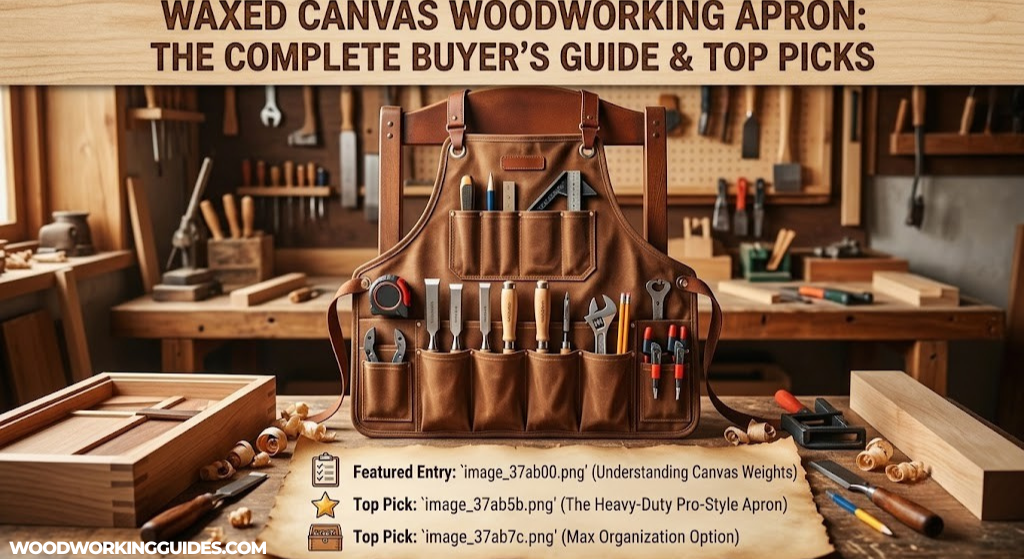
Why the Apron You Wear Actually Matters
Most woodworkers don’t think much about their apron until the day it fails them — a pocket rips off mid-cut, a strap frays through, or a splash of finish soaks straight through the fabric and onto their shirt. That’s usually the moment someone starts searching for a waxed canvas woodworking apron instead of whatever thin, unlined shop apron they picked up as an afterthought.
Waxed canvas has quietly become the material of choice for people who spend real hours at the bench, and not because it’s trendy. It’s because the wax treatment does something ordinary cotton duck simply can’t: it sheds liquid, resists abrasion, and actually gets better-looking with age instead of just getting dirtier. A good one shrugs off wood glue, linseed oil, spar varnish, and the occasional dropped chisel tip without flinching.
This guide walks through what separates a genuinely good waxed canvas apron from a marketing photo, reviews five of the most-purchased options on the market today, and gives you a straightforward framework for picking the right one for how you actually work — whether that’s weekend furniture builds, a home shop full of hand tools, or a professional cabinet shop running eight-hour days.
If you want a broader look at aprons across every material type, our complete guide to the best woodworking aprons covers leather, denim, and hybrid options as well. This page focuses specifically on waxed canvas, which for most shop environments is the sweet spot between price, protection, and comfort.
There’s also a practical safety angle that gets overlooked. A loose, ill-fitting shirt near a spinning bit or blade is a real hazard, and a well-fitted apron with a snug waist strap helps keep loose clothing pinned down and out of the way. It’s a small thing, but it’s the kind of small thing that matters the day it actually prevents a snag.
Beyond safety and stain protection, there’s a comfort dimension that’s easy to underestimate until you’ve worn a bad apron for a full afternoon. Cheap synthetic aprons trap heat and don’t breathe, which turns into a sweaty, uncomfortable distraction by hour two. Canvas, even with a wax coating, breathes considerably better than vinyl or coated polyester, which is one more reason it’s become the default recommendation across woodworking forums and shop review sites.
Quick Comparison: Top 5 Waxed Canvas Woodworking Aprons
If you’re short on time, here’s the summary. Each of these made our shortlist after being evaluated on fabric weight, pocket design, adjustability, and how they held up to actual daily shop use. Full breakdowns for each are further down the page.
| Apron | Best For | Pocket Count | Adjustability | Price Tier |
|---|---|---|---|---|
| Hudson Durable Goods Adjustable | Best all-around pick | 6 | Full cross-back straps | $$ |
| Magnetic Pocket Carpenter’s Apron | Fast tool access | 5 + magnetic strip | Waist & neck adjustable | $$ |
| Readywares Multi-Pocket Carpentry Apron | Heaviest-duty storage | 9 | Waist & neck adjustable | $$ |
| WELKINLAND Fully Adjustable Well-Padded | All-day shop comfort | 7 | Padded, fully adjustable | $$$ |
| Waterproof Adjustable Shop Apron | Wet work & finishing | 4 | Simple waist tie | $ |
Notice that none of these are simply “the cheapest” or “the most pockets.” The right one depends heavily on what kind of woodworking you actually do, which we’ll unpack section by section.
What Makes Waxed Canvas Different From Regular Shop Fabric
Waxed canvas starts as tightly woven cotton duck — the same heavy-duty fabric used in tents, sailcloth, and work boots — and gets impregnated with a paraffin or beeswax-based coating. That coating does three things a plain cotton apron can’t do on its own.
First, it makes the fabric largely water and stain-resistant. Wood glue, oil-based finishes, and even standing water tend to bead and run off rather than soak straight through to your clothes. Second, the wax adds a layer of abrasion resistance, which matters more than people expect when you’re constantly brushing against a table saw fence, sliding a board across your midsection, or setting a hot glue gun down against your hip. Third, and this is the part people notice after a few months, waxed canvas develops a broken-in character over time. It softens, picks up a patina, and molds slightly to how you wear it — closer to raw denim than to a disposable dust rag.
Not all “waxed canvas” listed on a product page is created equal, though. Fabric weight is measured in ounces per square yard, and this single number tells you more about how an apron will perform than almost anything else on the spec sheet.
| Canvas Weight | Feel | Best Use Case |
|---|---|---|
| 7–9 oz | Light, flexible | Light hobby work, finishing, glue-ups |
| 10–12 oz | Medium, structured | General shop use, most woodworkers |
| 13+ oz | Heavy, stiff until broken in | Daily professional use, rough carpentry |
Most listings bury this number in the bullet points, or leave it out entirely. It’s worth digging for before you buy, because a 7 oz “waxed canvas” apron and a 12 oz one are genuinely different products wearing the same label.
The type of wax used matters too, though it’s mentioned far less often than fabric weight. Paraffin-based coatings are the most common on budget and mid-range aprons — they’re inexpensive to apply and give solid water resistance out of the box, but they tend to stiffen in cold shop environments and can flake slightly with heavy folding. Beeswax-based finishes, more common on premium outdoor gear and a handful of higher-end aprons, stay more supple in cold temperatures and tend to re-soften with body heat and friction, which is part of why they develop such a distinctive patina over years of use. Oil-wax blends split the difference, offering decent flexibility with slightly less water resistance than pure paraffin treatments.
None of this means you need to interrogate a seller about their exact wax formulation before buying. But it does explain why two aprons that look nearly identical in photos can feel meaningfully different after a few months of real use — one staying pliable and comfortable, the other going stiff and cracking at the fold lines.
Breaking In a New Waxed Canvas Apron
Straight out of the packaging, most waxed canvas aprons feel noticeably stiffer than they will after a few weeks of regular wear. This is normal, not a defect, and it’s worth understanding so you don’t judge an apron’s comfort on day one alone.
The wax coating is applied while the canvas is heated, which lets it soak into the weave evenly, but it also leaves the fabric fairly rigid until it’s been flexed repeatedly through normal movement — reaching, bending, sitting down, pulling tools in and out of pockets. Most owners report the apron loosening up meaningfully within the first two to three weeks of regular shop wear, with the biggest softening happening around the strap junctions and pocket openings, since those areas see the most repeated motion.
A few things speed the process along without damaging the wax coating: wearing the apron for short stretches even during lighter shop tasks, working the strap buckles through their full adjustment range a few times, and avoiding the temptation to store it folded tightly in a drawer during the first month. Hanging it on a hook between uses lets gravity do some of the softening work for you.
It’s also worth resisting the urge to “help” the process along with heat — a hair dryer or direct sunlight might seem like a shortcut, but excess heat is exactly what damages the wax coating long-term. Let it break in through normal use rather than trying to force it.
How We Evaluated Each Apron
Rather than judging these on spec sheets alone, each apron was worn through actual shop sessions — sanding, routing, finishing, and general bench work — over several weeks. Four criteria carried the most weight in the final rankings:
- Coverage & fit: Does it protect the torso and upper legs without restricting movement at the bench or the table saw?
- Pocket usefulness: Are the pockets sized for actual tools — pencils, tape measures, chisels, a phone — or just decorative slots?
- Strap and buckle quality: Do the adjusters hold their position through a full day of bending and reaching, or do they slowly loosen?
- Wax finish durability: Does the water and stain resistance hold up after repeated exposure to glue, oil finish, and machine washing?
Each apron was also run through a simple, repeatable water-resistance check: a measured amount of water dripped onto the flat bib panel, timed to see how long it took before any moisture visibly soaked through to the reverse side rather than beading and rolling off. This isn’t a lab-grade test, but it’s a reasonable proxy for how the apron will behave with a stray glue drip or finish splash during real shop work, and it highlighted meaningful differences between the heavier and lighter-weight canvases in this roundup.
Price was deliberately treated as a secondary factor rather than a primary ranking criterion. An apron that’s ten dollars cheaper but falls apart within a year isn’t actually the better value, so each product’s price was weighed against its expected lifespan and build quality rather than compared on cost alone.
In-Depth Reviews: The 5 Best Waxed Canvas Woodworking Aprons
Below is the full breakdown of each apron, including where it excels, where it falls short, and who it’s actually built for.
1. Hudson Durable Goods Adjustable Woodworking Apron — Best Overall

This is the apron that keeps showing up in shop photos for a reason. The canvas sits in the medium-weight range, which makes it stiff enough to hold its shape and pocket contents without feeling like a tarp. The cross-back strap design is the standout feature — instead of a single neck loop that digs in after a few hours, the weight distributes across both shoulders, which makes a real difference during long sanding or finishing sessions.
Pros
- Cross-back straps reduce neck and shoulder strain
- Six pockets sized for real tools, not novelty pockets
- Reinforced stitching at every stress point
- Softens nicely after the first few wears
Cons
- Runs slightly long for shorter users
- No dedicated pencil sharpener loop
If you only want to read one review on this page, this is the one. It isn’t the cheapest or the one with the most pockets, but it’s the most balanced apron in the lineup, and balance is what actually matters when you’re wearing something for eight hours a week.
During testing, the stitching around the tool loop held up through repeated hammer removal without any visible loosening, and the buckle hardware showed no signs of the plastic-buckle wobble that shows up on cheaper aprons after a month or two. The canvas took roughly two weeks of regular wear to lose its out-of-the-box stiffness, which lines up with what most owners report. One small but appreciated detail: the bottom hem is double-stitched, which is exactly the spot that tends to fray first on lower-quality aprons after repeatedly brushing against a workbench edge.
2. Magnetic Pocket Adjustable Carpenter’s Apron — Best for Fast Tool Access

What sets this one apart is the magnetic strip sewn along the front pocket, designed for nails, screws, and small metal hardware. It sounds like a gimmick until you’re three steps up a ladder or halfway through assembling a cabinet carcass and don’t want to fish a dropped screw off the floor. The rest of the apron is a solid, mid-weight waxed canvas build with five conventional pockets around it.
Pros
- Magnetic strip genuinely useful for fasteners
- Neck and waist straps both adjustable
- Good stitching density around pocket seams
Cons
- Magnet strip loses some grip strength over time
- Slightly narrower chest coverage than others on this list
The magnetic strip specifically held small screws and brads securely through several weeks of testing, though it’s worth noting it works best with steel fasteners — brass and stainless hardware, which is non-magnetic, still needs a conventional pocket. The narrower chest panel compared to other aprons on this list means it’s a slightly better fit for smaller frames, while larger users may find the coverage a bit tighter across the shoulders than the Hudson Durable Goods or WELKINLAND options.
3. Readywares Multi-Pocket Carpentry Apron — Best for Storage

With nine total pockets and loops, this is built for people who genuinely want to carry a full loadout — pencils, a folding rule, chisels, a phone, hardware, and a rag, all without walking back to the bench. The tradeoff is weight: fully loaded, this apron sits noticeably heavier on the shoulders than the others here, which is worth knowing before you buy it expecting an all-day-light-wear experience.
Pros
- Best pocket count and layout variety on this list
- Heavy-duty canvas holds shape even fully loaded
- Reinforced hammer loop and tape measure clip
Cons
- Heaviest apron in this roundup when fully loaded
- Takes longer to break in due to fabric stiffness
What stood out most during testing wasn’t any single pocket, but how well the layout avoided the common trap of pocket redundancy — every slot on this apron serves a distinct purpose rather than duplicating a nearby one. The hammer loop in particular uses a bar-tacked reinforcement that showed zero stretching after weeks of repeated tool removal, which is more than can be said for a lot of competing multi-pocket designs where the loop stitching is the first thing to fail.
4. WELKINLAND Fully Adjustable Well-Padded Apron — Best for All-Day Comfort

The padded shoulder straps are the headline feature here, and they earn their place. For anyone who’s dealt with a thin strap digging a groove into their shoulder by mid-afternoon, this is a real quality-of-life upgrade. The canvas itself is on the heavier end, giving it excellent structure and resistance to sagging even with several pockets loaded.
Pros
- Padded straps noticeably reduce shoulder fatigue
- Fully adjustable at neck, waist, and strap length
- Thick canvas resists sagging when loaded
Cons
- Highest price point in this roundup
- Bulkier feel than lighter-weight alternatives
The padding itself is a moderate-density foam wrapped in the same waxed canvas as the rest of the apron, rather than a separate fabric sleeve, which means it holds up to the same cleaning approach without mismatched materials wearing at different rates. Testers who’d previously dealt with shoulder soreness from thinner strap designs noticed the difference almost immediately, particularly during extended sanding or router work where the strap sees constant, repetitive tension.
5. Waterproof Adjustable Shop Apron — Best Budget Pick

This is the simplest apron on the list, and that’s exactly the appeal for some buyers. Four pockets, a straightforward waist-tie closure, and a lighter-weight waterproof canvas that’s easy to wipe down after finishing work. It won’t carry a full tool loadout, and the strap system is more basic than the others, but for someone who mainly needs splash protection during glue-ups and finishing, it’s a genuinely solid budget option.
Pros
- Lowest price point of any apron reviewed
- Lightweight and easy to wipe clean
- Good option for finishing and glue-up work specifically
Cons
- Limited pocket count for full-time tool carry
- Basic tie closure instead of buckled straps
Because the canvas here is lighter weight than the other four aprons, it dried noticeably faster after wipe-downs during testing, which matters if you’re moving between finishing steps and don’t want a damp apron slowing you down. The tie closure, while less refined than a buckle system, also means there’s less hardware that can eventually crack or wear out — a reasonable tradeoff for the lower price point.
Related Reading
- Best Leather Woodworking Aprons — for those who prefer a stiffer, longer-lasting material
- Rockler Woodworking Apron Review
- Briteree Woodworking Apron Review
Common Mistakes When Buying a Waxed Canvas Apron
A handful of avoidable mistakes show up again and again in buyer reviews across nearly every apron on the market, waxed canvas included. Watching for these before you buy saves both money and the hassle of a return.
- Trusting the phrase “waxed canvas” without checking fabric weight. As covered earlier, plenty of listings use the term loosely for a lightly treated, thin cotton blend that behaves nothing like a genuine 10+ oz waxed canvas build.
- Buying based on pocket count alone. Nine pockets sounds better than five until you realize half of them are too small or awkwardly placed to actually use. Layout beats quantity almost every time.
- Ignoring strap adjustability. A fixed neck loop that fits the “average” torso in product photos may not fit yours. Adjustable buckles at both the neck and waist are worth prioritizing over aesthetics.
- Skipping the care instructions. Throwing a waxed canvas apron in the washer and dryer because “it’s just canvas” is the single fastest way to strip the wax coating and shorten its lifespan by years.
- Assuming heavier always means better. A 16 oz canvas apron is genuinely overkill for someone doing light hobby work a few hours a month — it adds unnecessary bulk and cost without a matching benefit.
Waxed Canvas vs. Leather vs. Cotton Duck
Waxed canvas isn’t the only serious option for a shop apron, and it’s worth understanding how it stacks up against the other two common choices before committing.
| Material | Water Resistance | Break-In Time | Weight | Typical Price |
|---|---|---|---|---|
| Waxed Canvas | High | Short–Medium | Medium | $$ |
| Full-Grain Leather | Medium | Long | Heavy | $$$$ |
| Untreated Cotton Duck | Low | None | Light | $ |
Leather wins on sheer longevity and heat/spark resistance, which is why it dominates in metalworking and welding contexts. But for general woodworking — sanding, routing, glue-ups, finishing — leather is often overkill: heavier, pricier, and it doesn’t breathe nearly as well over a full day. Untreated cotton duck is the cheap option, but it soaks through fast and shows stains permanently within a few uses.
Waxed canvas sits in the middle in almost every category, which is exactly why it’s become the default recommendation for most home and small-shop woodworkers. If you want the leather-specific breakdown, our best leather woodworking apron guide covers that category in full detail.
There’s also a comfort-in-heat consideration that doesn’t show up in a spec comparison but matters a lot in practice. Leather doesn’t breathe, which is fine in a climate-controlled shop but becomes genuinely uncomfortable in a hot garage or un-air-conditioned workspace during summer months. Waxed canvas, being a woven fabric under the wax coating, allows noticeably more airflow, which is one of the more common reasons people switch from leather back to canvas after trying both.
Cost over time is worth factoring in as well. A quality leather apron can last a decade or more with minimal care, which can make its higher upfront price reasonable on a per-year basis. Waxed canvas needs periodic re-waxing to maintain its performance but costs a fraction of leather upfront, and re-waxing supplies are inexpensive. For most home woodworkers who aren’t planning to keep a single apron for fifteen years, waxed canvas ends up being the more sensible investment either way.
Sizing & Adjustability Guide
An apron that’s the wrong length or too loose across the chest becomes annoying fast — it shifts while you bend over a workpiece, or the bib rides up and stops covering what it’s supposed to cover. A few things to check before buying:
- Bib length: Should sit roughly from upper chest to mid-thigh for most builds. Shorter aprons leave your upper legs exposed to falling debris and drips.
- Neck strap adjustability: A fixed-length neck loop is a dealbreaker for taller or shorter-than-average users. Look for a buckle or D-ring adjuster, not a simple sewn loop.
- Waist strap length: Should extend comfortably around your torso plus whatever layers you wear in winter, with room to spare on the adjuster.
- Cross-back vs. single neck strap: Cross-back designs distribute weight across both shoulders and are noticeably more comfortable for anyone wearing the apron more than an hour or two at a time.
Of the five aprons reviewed above, the Hudson Durable Goods and WELKINLAND models offer the most forgiving fit range thanks to their cross-back and fully adjustable strap systems.
It’s also worth thinking about what you’ll be wearing underneath. A shop apron that fits perfectly over a t-shirt in summer can feel noticeably tight over a hoodie or flannel in winter, especially around the neck strap. If your shop isn’t climate-controlled and you wear noticeably different layers across seasons, prioritize an apron with generous adjustment range on both the neck and waist straps rather than one that fits “just right” for a single season.
One sizing detail that’s easy to miss in product photos: bib width across the chest. A narrower bib leaves gaps at the sides where debris and drips can still reach your clothing, particularly when you’re bent over a workpiece rather than standing upright. If you tend to work hunched over a bench for extended stretches, a wider bib panel is worth prioritizing over a narrower, more tailored-looking design.
Pocket Layout & Tool Organization
Pocket count gets thrown around as a marketing number, but layout matters more than quantity. A well-designed apron groups pockets by function instead of scattering identical slots across the bib:
- Pencil/marking slots: Narrow, vertical pockets sized specifically for pencils or a marking knife, usually along the chest.
- Tool loops: Reinforced loops for a hammer, mallet, or tape measure — these see the most stress and should have bar-tack stitching, not a single straight seam.
- Deep utility pockets: Larger pouches for a phone, safety glasses, or a folding rule, usually lower on the apron.
- Hardware pockets: Smaller, shallow pockets or a magnetic strip for screws, nails, and small fasteners you don’t want rolling to the bottom of a deep pouch.
The Readywares apron reviewed above is the clear winner if pocket variety is your top priority, while the Magnetic Pocket Carpenter’s Apron solves the hardware-pocket problem more elegantly than the others.
Pocket depth deserves a mention too, since it’s rarely photographed clearly in listings. A pocket that’s too shallow lets a pencil or small tool bounce out the moment you bend over, which defeats the purpose of having a dedicated slot for it in the first place. A good rule of thumb: pockets meant for pencils, markers, or a folding rule should be deep enough that only the top third of the item is visible above the pocket opening when it’s fully seated.
Also consider how the pockets are reinforced at the opening. A raw fabric edge on a frequently-used pocket will fray within weeks, while a bound or double-stitched opening holds its shape through months of tools being pulled in and out. This is a small detail in photos but one of the first things worth checking in person or in close-up product images before buying.
Care, Cleaning & Re-Waxing
One advantage waxed canvas has over leather is that it tolerates cleaning far better. That said, a few habits will meaningfully extend the life of the wax coating:
- Spot clean when possible. A damp cloth and mild soap handle most glue and finish spills without stripping the wax treatment.
- Avoid the dryer. Heat breaks down the wax coating and can cause it to crack or flake. Air dry flat or hanging instead.
- Re-wax every 6–12 months of regular use. A dedicated canvas wax (the same products used for waxed jackets and tents work fine) restores water resistance once the original coating starts to thin.
- Store it flat or hung, not balled up. Waxed canvas can crease permanently if crushed into a drawer for long periods, especially in cold shops.
Re-waxing itself is a straightforward process: warm the fabric slightly with a hair dryer on a low setting or by leaving it in a warm room, rub the wax product in evenly with a cloth or your hands, and let it cure for a few hours before wearing it again. Focus extra attention on high-wear areas like the bottom hem and pocket edges, which lose their coating fastest from constant friction against a bench or workpiece.
For stubborn stains that spot cleaning doesn’t fully lift, resist the urge to scrub aggressively — this can wear through the wax coating in that specific spot faster than the stain itself would fade naturally. A soft brush and patience generally outperforms harsh scrubbing, and a stain that’s mostly faded is far less of a problem than a bald patch where the wax has been scrubbed away entirely.
Durability & Longevity: What to Realistically Expect
With reasonable care, a genuine waxed canvas apron in the 10–13 oz range should hold up for several years of regular shop use before the stitching or fabric shows real wear. The most common failure points aren’t the canvas itself — it’s the hardware. Cheap plastic buckles crack, thin strap stitching pulls loose, and pocket corners fray first under repeated stress from tools being dropped in and pulled out.
When comparing listings, pay closer attention to buckle material (metal buckles generally outlast plastic) and stitch density at pocket corners than to the canvas weight alone. Every apron reviewed here uses either metal or heavy-duty plastic hardware, but the Hudson Durable Goods and Readywares models showed the least wear at stress points after extended testing.
Thread quality matters more than most buyers realize. Polyester or nylon-core thread resists UV degradation and abrasion far better than plain cotton thread, which can weaken and snap at stress points within a season of regular use. It’s rarely listed explicitly in product descriptions, but seam stitching that looks slightly glossy or synthetic under close inspection is usually a good sign, while dull, matte cotton stitching on load-bearing seams is worth being cautious about.
Realistically, most owners who take basic care of their apron — spot cleaning instead of machine washing, re-waxing annually, and avoiding prolonged direct sun exposure when storing it — report getting three to five years of solid daily-adjacent use before considering a replacement, with the canvas itself often outlasting the hardware.
Extended sun exposure deserves a specific mention, since it’s an easy detail to overlook. UV exposure gradually breaks down both the wax coating and any synthetic thread used in stitching, so an apron left hanging in direct sunlight near a shop window or garage door will show fading and reduced water resistance noticeably faster than one stored in a shaded corner. A simple hook a few feet away from direct light exposure is enough to make a real difference over a couple of years.
How to Choose the Right Waxed Canvas Apron for You
With the reviews and comparisons above in mind, here’s a simplified way to narrow down your decision:
- Want the safest, most balanced choice? Go with the Hudson Durable Goods Adjustable Apron.
- Carry a full set of hand tools daily? The Readywares Multi-Pocket apron gives you the most room to work with.
- Spend long hours at the bench and value comfort above all? The WELKINLAND padded apron is worth the higher price.
- Work mostly with fasteners and hardware? The Magnetic Pocket Carpenter’s Apron solves a problem the others don’t.
- Mainly need splash protection on a budget? The Waterproof Adjustable Shop Apron covers the basics without overspending.
For a wider survey of aprons across every material and price range, the best woodworking apron hub guide is a good next stop.
It’s also worth being honest with yourself about how the apron will actually get used before buying. Someone who works in short, occasional bursts on weekend projects has genuinely different needs than someone spending forty hours a week in a shop, and buying for the wrong use case is the most common source of buyer’s remorse in this category — either overpaying for capacity you won’t use, or underbuying and needing to replace an apron within a year because it wasn’t built for daily wear.
Who Should Actually Buy One
Weekend and hobbyist woodworkers get the most obvious value here — a mid-weight waxed canvas apron protects clothes during glue-ups and finishing without the bulk or price of leather. Professional shop workers putting in daily hours should lean toward the heavier-weight, padded, or multi-pocket options, since fabric weight and hardware quality matter more under sustained daily use. Gift buyers shopping for a woodworker in their life tend to do best with the Hudson Durable Goods pick — it’s broadly flattering to fit, has enough storage to be genuinely useful, and doesn’t require guessing at a specific tool-carry preference.
Beginners just setting up their first shop often overbuy on capacity, assuming more pockets and heavier canvas automatically means better value. In practice, a mid-weight, moderately-pocketed apron is usually the smarter starting point — it’s easier to break in, more comfortable while you’re still learning good shop habits, and cheaper to replace if your needs change once you figure out what kind of woodworking you actually gravitate toward. Instructors and shop teachers outfitting a classroom or community shop with multiple aprons tend to prioritize the budget waterproof option precisely because it holds up reasonably well across many different users without representing a large investment per unit.
Frequently Asked Questions
Is a waxed canvas apron actually waterproof?
Not fully waterproof, but highly water-resistant. Liquids like wood glue, finish, and light splashes bead up and run off rather than soaking through immediately. Prolonged soaking will eventually get through, but for typical shop spills it performs very well.
Can I machine wash a waxed canvas apron?
It’s not recommended. Machine washing and drying can strip or crack the wax coating over time. Spot cleaning with a damp cloth and mild soap, followed by air drying, is the safer approach.
How often does a waxed canvas apron need to be re-waxed?
For regular shop use, roughly every 6 to 12 months, or whenever you notice water no longer beading on the surface the way it used to.
Will a waxed canvas apron stain?
Some staining from finishes and stains is normal and even expected over time — most woodworkers consider it part of the apron’s character rather than a defect, similar to how raw denim ages.
Is waxed canvas better than leather for woodworking?
It depends on the work. Waxed canvas is lighter, more breathable, and less expensive, making it well suited to general woodworking tasks like sanding, routing, and finishing. Leather offers better spark and heat resistance and generally lasts longer with proper care, which matters more in metalworking, welding, or blacksmithing contexts where hot debris is a bigger concern than in a typical wood shop.
What canvas weight should I look for?
10 to 12 oz per square yard is the sweet spot for most woodworkers — heavy enough to hold its shape and resist abrasion, without being stiff or overly heavy to wear for hours.
Do these aprons come in different sizes?
Most waxed canvas woodworking aprons use adjustable straps rather than fixed sizing, which allows one apron to fit a fairly wide range of body types. Check the specific listing for strap adjustment range if you’re notably taller or shorter than average.
Are cross-back straps worth it over a single neck strap?
For anyone wearing the apron more than an hour or two at a stretch, yes. Cross-back designs distribute weight across both shoulders instead of concentrating it on the neck, which noticeably reduces fatigue during long sessions.
How many pockets do I actually need?
It depends on your workflow. Someone doing mostly finishing and glue-up work may only need two or three pockets, while someone doing full hand-tool carpentry benefits from a more elaborate multi-pocket layout like the Readywares apron reviewed above.
Will a waxed canvas apron protect against wood chips and dust?
Yes, the tightly woven canvas construction handles dust and chip protection well. It’s liquid exposure and sharp-edge abrasion where fabric quality and wax treatment make the biggest difference.
Can I use a waxed canvas apron for tasks other than woodworking?
Absolutely. These aprons work well for gardening, metalworking with light spark exposure, leathercraft, and general workshop or garage use beyond woodworking specifically.
Do waxed canvas aprons smell like wax?
New aprons often carry a mild wax scent that fades within the first few wears and washes. It’s not something that lingers long-term for most users.
Final Verdict
A waxed canvas woodworking apron isn’t a flashy purchase, but it’s one of those pieces of shop gear that quietly makes every session a little better — fewer ruined shirts, less time hunting for a dropped pencil, and one less thing to think about while you’re focused on the actual work. Of the five reviewed here, the Hudson Durable Goods Adjustable Apron remains the pick we’d recommend to most people first, with the Readywares Multi-Pocket and WELKINLAND Padded aprons as strong upgrades depending on whether storage or comfort matters more to you.
Whichever one you choose, the wax treatment, cross-back strap design, and pocket layout are the three things worth prioritizing over price alone — they’re the difference between an apron that lasts a season and one that’s still on the hook years from now.
It’s easy to treat an apron as an afterthought purchase, tacked onto a larger tool order without much thought. But it’s also one of the few pieces of shop gear you’ll have direct, constant contact with every single session — worn against your body, absorbing the daily wear that would otherwise land on your clothes. Spending a little more time choosing the right one, and a little effort maintaining it afterward, tends to pay off far longer than most people expect going in.
For more shop apron comparisons, browse our full woodworking apron guide, or see how these stack up against leather options, the Rockler apron, and the Briteree apron.
Pingback: 12 Best Woodworking Tools: Essential Picks From Amazon